Insurance compliance matters before every drive
Washington State Insurance Requirements Guide for Drivers and Coverage

Content
If you're driving in Washington, here's something that might surprise you: the state won't accept a bond or cash deposit instead of insurance. You need an active policy, period. That's different from California or Virginia, where drivers have other options.
Why so strict? Washington runs a fault-based system. When you cause a wreck, your insurance pays for what you damaged. The state wants to make sure that money actually exists. And if you let your coverage expire—even by accident—you're looking at a suspended license, a $400+ reinstatement fee, and three years of filing special paperwork with the state.
Most drivers don't realize how serious Washington is about this until they face these consequences firsthand.
Minimum Coverage Requirements Under Washington Law
Washington law sets specific dollar amounts for liability insurance. Every driver needs what's called 25/50/10 coverage:
- $25,000 per person for injuries — This caps what your insurer will pay one person you injure
- $50,000 total per accident for injuries — The maximum for everyone hurt in one crash
- $10,000 for property you damage — Covers cars, fences, buildings, whatever you hit
These numbers haven't changed in decades. Meanwhile, healthcare costs have tripled. A friend of mine broke his femur in a motorcycle accident last year—just the emergency surgery ran $38,000 before rehab. If someone carrying minimum coverage had caused that crash, they would've been personally responsible for the remaining $13,000.
You have to carry proof every time you drive. That means either a paper insurance card in your glove box or the digital version on your phone. Cops check during traffic stops. The Department of Licensing verifies when you renew your tabs. Accident investigators ask for it at crash scenes.
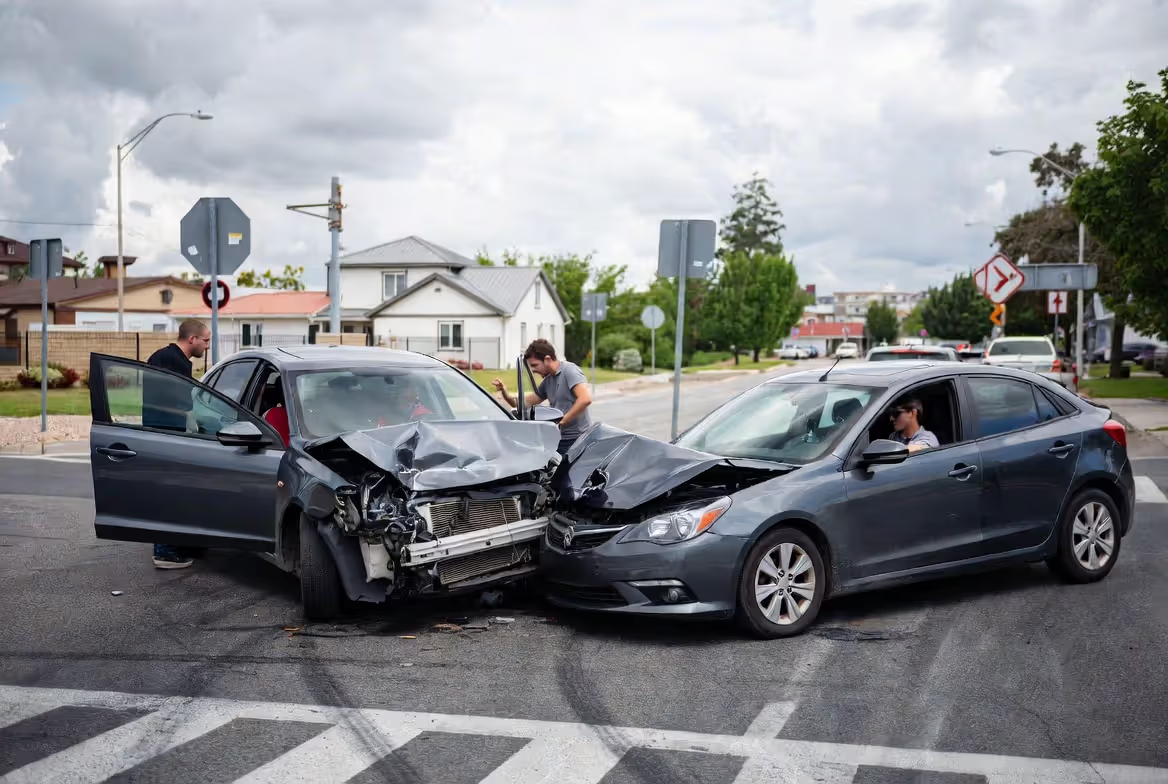
Get caught without insurance? First offense hits you with $450 in fines plus a $75 fee to get your license back. But here's the part that really stings—you'll need what's called an SR-22 certificate for the next three years. That's not insurance itself; it's your insurance company promising the state you're staying covered. Any lapse during those three years resets the clock back to zero.
Your insurance company reports cancellations to the state within three business days. Washington doesn't use license plate readers to catch uninsured drivers like some states do, but this reporting system works almost as well. Eventually, the state finds out.
Author: Tara Livingston;
Source: trialstribulations.net
How WA Liability Laws Differ From Other States
Washington uses what's called a tort system. That means when someone causes an accident, their insurance pays the bills. Sounds obvious, right? Except 12 states do it completely differently.
In Florida or Michigan, your own insurance pays first regardless of who caused the crash. Those are called no-fault states. Washington rejected that approach. Here, if you rear-end someone, your liability coverage handles their medical bills and car repairs. You can't hide behind no-fault rules.
This creates a big problem when you're underinsured. Let's say you carry the $25,000 minimum and cause an accident where someone needs $80,000 in medical treatment. Your insurance pays their $25,000 limit, then they sue you personally for the remaining $55,000. They can garnish your wages. Put liens on your house. Tap your bank accounts. The state won't protect you from that judgment.
Washington follows what lawyers call "pure comparative negligence." Only 13 states use this system. Here's what it means in practice: even when you're mostly at fault, you can still collect damages based on the other driver's percentage of blame.
Let's say you're changing lanes without checking your blind spot. Another driver is speeding 20 mph over the limit. You collide. The investigation determines you're 80% at fault, but the speeding driver is 20% responsible. If total damages hit $10,000, you can still recover $2,000 (your 20% share).
Compare that to Oregon, right across the Columbia River. They use modified comparative negligence. If you're 51% or more at fault, you get nothing. Washington's system is more forgiving—but it also means settlements take longer because both sides argue over those percentages.
You have three years to file a lawsuit after an accident. That applies to both injury claims and property damage. Miss that deadline by even a day? Your case gets dismissed. Courts don't make exceptions. I've seen people lose valid six-figure claims because they waited too long to file.

Author: Tara Livingston;
Source: trialstribulations.net
What Happens After an At-Fault Accident
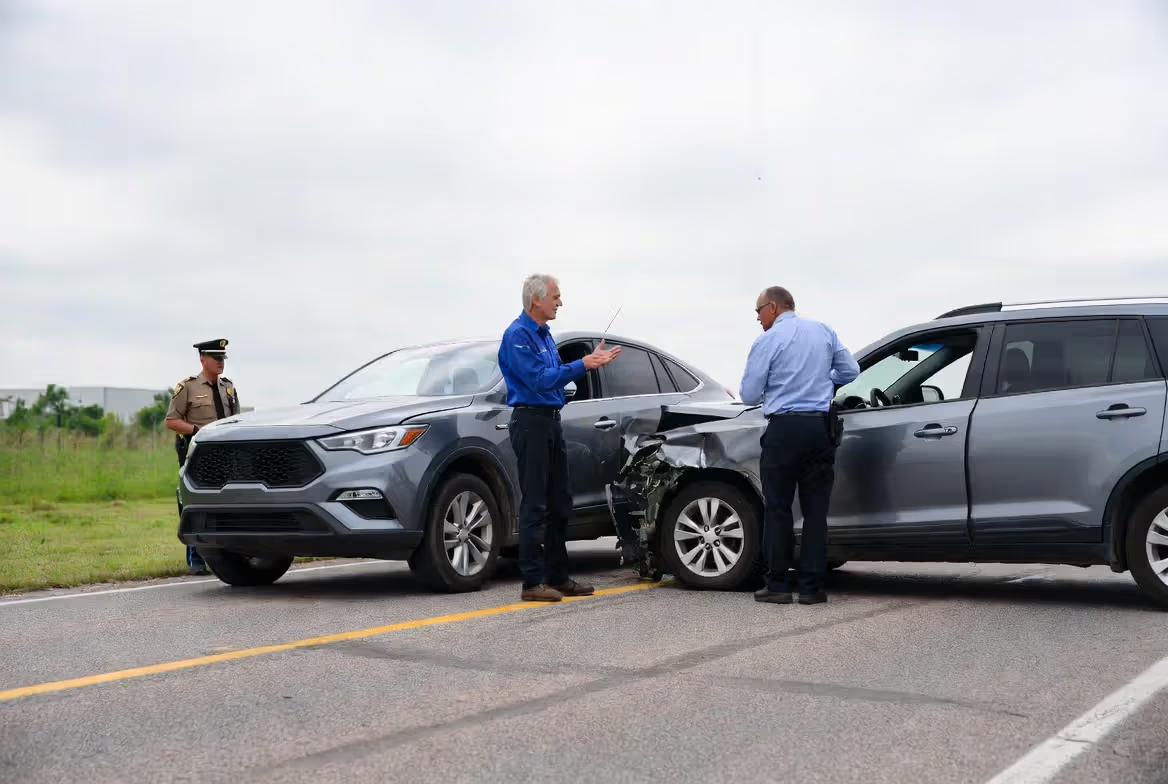
When you cause a crash, the other driver files a claim with your insurance company. An adjuster investigates—talks to witnesses, reviews police reports, inspects vehicle damage. If they accept that you're at fault, they'll negotiate a settlement up to your policy limits.
Here's where minimum coverage becomes dangerous. Imagine carrying that $25,000-per-person limit. You cause a crash. The injured driver needs two surgeries, misses three months of work, and requires ongoing physical therapy. Total cost: $95,000. Your insurer cuts a check for their $25,000 maximum and closes their file. The injured driver now has a $70,000 reason to sue you directly.
Some drivers think bankruptcy will erase this debt. Not always. While Chapter 7 can discharge some accident-related judgments, courts sometimes classify them as non-dischargeable if you were grossly negligent or intoxicated.
Washington sometimes allows "stacking" coverage from multiple policies. If you're driving your friend's car when you cause an accident, both your personal policy and your friend's policy might provide coverage. The specific rules depend on policy language and circumstances, but this can double your available coverage in some situations.
Comparative Negligence Rules in Washington
Insurance adjusters assign fault percentages to everyone involved in a crash. These numbers determine how much each party can recover. When fault is clear-cut—like a rear-end collision at a stoplight—settlements usually wrap up in 60 to 90 days.
But when both drivers share blame, negotiations drag on. Adjusters argue over percentages. One company claims their driver was 30% at fault. The other insists it's 60%. These disputes often take six months or more to resolve, sometimes ending up in court.
Good documentation changes everything. Dash cam footage showing exactly what happened can shift fault determinations by 20 or 30 percentage points. That's thousands of dollars in a significant accident. Same goes for witness statements and detailed police reports.
Washington doesn't require police reports for minor accidents—crashes below certain damage thresholds. But filing one anyway creates an official record that's invaluable during claims. I always file reports regardless of damage estimates, because that initial $1,200 estimate often becomes $3,800 once the body shop finds hidden frame damage.
Author: Tara Livingston;
Source: trialstribulations.net
Average Insurance Premiums in Washington: Cost Breakdown by County
Full coverage in Washington runs about $1,420 per year on average. That's roughly 8% less than what Americans pay nationally. But state averages hide dramatic differences between Seattle and Spokane.
Check out these numbers from major counties:
| County | Typical Yearly Cost | Difference vs. State Average | What Drives These Rates |
| King | $1,687 | 18.8% higher | Seattle's car theft epidemic, gridlock traffic, pricey repairs |
| Pierce | $1,523 | 7.3% higher | Tacoma sees more crashes per capita than state average |
| Spokane | $1,289 | 9.2% lower | Less dense traffic, cheaper medical care, lower property values |
| Snohomish | $1,556 | 9.6% higher | Suburban sprawl means more miles driven, more commuter accidents |
| Clark | $1,398 | 1.5% lower | Mix of urban and rural, some drivers cross to Oregon for work |
| Washington Average | $1,420 | baseline | — |
| U.S. Average | $1,547 | 8.9% more expensive | — |
Someone living in King County pays $398 more each year than a Spokane County resident for identical coverage. That's a 31% difference driven mostly by Seattle's concentration of expensive cars, sky-high labor rates at body shops, and relentless comprehensive claims for broken windows and stolen catalytic converters.
But county averages still don't tell the whole story. Your specific ZIP code matters more. Downtown Seattle drivers pay 15-20% more than someone in rural King County—say, Carnation or Duvall. Insurers divide counties into rating territories, sometimes drawing lines right through neighborhoods.
Washington faces some unique rating factors. About 12-14% of drivers here have no insurance, according to Insurance Research Council data. That's worse than the national average. When uninsured drivers cause accidents, insured drivers effectively subsidize those claims through higher base rates.
Weather plays a role too. Western Washington's perpetual drizzle from October through March contributes to more fender-benders. Eastern Washington deals with black ice and occasional severe storms. Insurers track these patterns by region and adjust rates accordingly.
Beyond the Minimum: Additional Coverage Worth Considering
Minimum liability coverage protects everyone except you. Your own vehicle, medical bills, and lost wages? Those aren't covered unless you add more to your policy.

Author: Tara Livingston;
Source: trialstribulations.net
Uninsured/underinsured motorist coverage (UM/UIM) might be the smartest money you'll spend. Washington law says insurers must offer this to you, though you can decline it in writing. Given how many uninsured drivers roam Washington roads, turning this down seems reckless.
UM/UIM typically adds $100-200 to your annual premium. It covers your medical expenses and lost income when an uninsured driver hits you—or when their coverage isn't enough to pay your bills. You file the claim with your own insurance company, who pays you and then hunts down the at-fault driver for reimbursement. This arrangement means you get money faster for medical treatment instead of waiting months while fault gets determined.
Comprehensive and collision coverage make sense based on your car's value. Here's a quick test: if the combined annual premium for these coverages exceeds 10% of your car's actual value, consider dropping them. Your 2012 Honda worth $3,500? Probably not worth paying $450 a year to insure it against physical damage. Just save that money in case you need to replace it.
Personal injury protection (PIP) isn't required in Washington, but companies must offer it to you. PIP functions like a mini no-fault system within Washington's fault-based framework. It pays your medical bills and lost wages regardless of who caused the accident. Standard limits range from $10,000 to $35,000.
PIP becomes valuable when you're at fault and lack health insurance. It also helps when your health insurance has a $5,000 deductible and you need immediate treatment. Some drivers skip PIP because they have good health insurance, but remember—PIP covers lost wages too, which your health plan doesn't touch.
Gap insurance matters if you financed your vehicle or signed a lease. Most new cars depreciate 20-30% the moment you drive off the lot. If you total that car six months later, your collision coverage pays its actual cash value—often thousands less than your loan balance. Gap coverage pays that difference, preventing you from making monthly payments on a crushed vehicle sitting in a junkyard.
Common Compliance Mistakes Washington Drivers Make

Author: Tara Livingston;
Source: trialstribulations.net
Coverage lapses cause more license suspensions than any other violation. Here's the typical scenario: your credit card expires. Your insurance payment bounces. The company sends a cancellation notice to your old address because you forgot to update it. Ten days later, your coverage terminates.
Your insurance company notifies the Department of Licensing within three business days. Even if you immediately purchase new coverage, that gap appears on your record. Now you need SR-22 filing, reinstatement fees, and you'll see rate increases when your insurer discovers the lapse during their next underwriting review.
Minimum coverage creates a false sense of security. Drivers assume that meeting the legal requirement means they're protected. Then they cause a serious accident and discover their $25,000 coverage doesn't begin to cover the $150,000 in damages. Suddenly they're facing wage garnishment, liens against their house, and possibly bankruptcy.
Try this quick test: if your net worth tops $100,000, you need way more than minimum limits. That includes home equity, retirement accounts, investment portfolios—anything a judgment creditor could pursue. Many insurance professionals suggest $100,000/$300,000/$100,000 as a baseline for middle-income households. Add an umbrella policy for another $1-2 million in coverage at just $200-300 per year.
Moving without updating your policy address violates your insurance contract. Insurers calculate rates based on where you park overnight—your "garaging location" in insurance speak. If you move from Spokane to Seattle but keep paying Spokane rates, you're technically misrepresenting your risk.
What happens when you file a claim? Your insurer investigates and discovers you've been living in Seattle for eight months. They might deny the claim entirely or reduce payment based on material misrepresentation. Even if they pay, they'll likely cancel your policy afterward.
SR-22 requirements confuse almost everyone. An SR-22 isn't a special type of insurance—it's a certificate your insurance company files with the state proving you're maintaining coverage. The filing itself costs about $25-50, but associated premium increases typically run 30-50% because you're now classified as high-risk.
You need to maintain SR-22 status for three full years without interruption. One missed payment resets that three-year clock to day one. And SR-22 doesn't automatically disappear after three years—you need to contact your insurer and request they stop filing it.
I see this pattern every week in my practice. Drivers think $25,000 covers them—until they cause an accident. One client rear-ended a car at maybe 35 mph. Didn't seem that serious. The other driver ended up needing shoulder surgery that cost $67,000. My client had minimum limits, so his insurance paid their $25,000 maximum and closed the file. He got sued for the remaining $42,000. Eventually settled by agreeing to wage garnishment for five years. Here's what kills me: bumping his coverage to $100,000 would've cost an extra $180 annually—about $15 per month. That tiny investment would've protected everything he'd spent years building.
— Jennifer Marquez
How to Lower Your Insurance Costs While Staying Compliant
Shopping around delivers the biggest savings. Washington's competitive market means identical coverage quotes can differ by $500-800 annually between companies. Get quotes from at least five insurers every two years. Your risk profile changes. Each company's appetite for your demographic shifts. Loyalty doesn't pay in insurance.
Bundling multiple policies consistently cuts costs. Combine your auto insurance with homeowners or renters coverage through one company, and you'll typically save 15-25% on both policies. Even if bundling costs slightly more than separate policies, having one company handle all your claims often justifies a small price difference.
Defensive driving courses approved by Washington's DOL qualify for discounts at most insurers. These courses run 4-8 hours, cost $25-60, and you can complete many online. The reward? Premium reductions of 5-15% for three years. Drivers over 55 often see larger discounts, making the course cost-effective after just the first year.
Vehicle safety features impact what you pay. Anti-theft systems, anti-lock brakes, electronic stability control, and newer safety tech like forward collision warnings—all trigger discounts. When you're shopping for a car, factor in that safety features might save you $100-300 annually over the vehicle's lifetime.
Credit scores influence Washington premiums significantly, though state law limits how insurers can use credit data. Improving your score by paying bills on time and reducing debt can cut premiums 10-20% over time. Washington prohibits insurers from canceling or refusing to renew based solely on credit scores, but they can use scores when initially pricing your policy.
Raising your deductibles reduces premiums immediately. Increase your comprehensive and collision deductibles from $500 to $1,000, and you'll typically cut 15-20% from those coverage costs. The catch? You'll pay more out-of-pocket for claims. This strategy works best when you have emergency savings to cover that higher deductible.
Usage-based insurance programs (telematics) reward safe driving with discounts. You install a device in your car or use a smartphone app that monitors your speed, hard braking, sharp turns, and total miles driven. Safe drivers can save 10-30%. Aggressive driving might increase your premiums. These programs work well if you're confident in your driving habits and don't mind the data collection aspect.
Low-mileage discounts kick in when your annual driving drops below 7,500-10,000 miles. Remote workers and retirees often qualify. Some insurers now offer pay-per-mile policies where you pay a small base rate plus a charge for each mile driven. Truly low-mileage drivers can save 30-40% this way.
Frequently Asked Questions About Washington Auto Insurance
Making Informed Coverage Decisions
Washington's insurance minimums represent a legal floor, not a recommendation for adequate protection. The enormous gap between $25,000 coverage and what serious accidents actually cost leaves too many drivers financially exposed.
Smart coverage decisions balance what you pay monthly against your real-world risk exposure. Consider your assets, income, and potential liability. Someone with $200,000 in home equity and $400,000 in retirement savings needs substantially more than minimum coverage. Judgment creditors can pursue those assets for years after an accident through wage garnishment and liens.
Start by requesting quotes for higher liability limits—$100,000/$300,000/$100,000 often costs surprisingly little more than minimums with many carriers. Add UM/UIM coverage matching your liability limits. Evaluate comprehensive and collision coverage based on your vehicle's actual value and whether you could replace it out-of-pocket without financial hardship.
Review your coverage every year, not just when renewal notices arrive. Major life changes—getting married, buying a house, receiving a promotion—all warrant coverage adjustments. The policy that worked when you were 25, single, and renting an apartment probably leaves you dangerously exposed at 35 with a family, mortgage, and substantial assets.
Washington's fault-based system places financial responsibility directly on drivers who cause accidents. Unlike no-fault states where your own insurance handles claims regardless of fault, Washington drivers face personal liability for damages they cause. This system makes adequate liability coverage essential—not just to satisfy state law, but to protect everything you've worked years to build.