Georgia’s minimum limits can run out quickly after a serious crash.
Georgia Car Insurance Laws Guide to Coverage Rules and Penalties

Content
Every vehicle on Georgia roads must have active liability insurance. Period. It's not optional, and it's not negotiable. Yet about 12% of drivers around you on I-285 or Highway 400 are operating cars with zero coverage—making them ticking financial time bombs if they crash into you.
Georgia's approach? Force every driver to carry enough insurance to cover basic damages they might cause. The system tries to protect crash victims while keeping premiums low enough that people actually buy coverage instead of driving illegally.
Here's the reality: The mandatory minimums won't come close to covering a serious wreck. Someone breaks their leg in an accident you cause? Surgery alone hits $40,000 before physical therapy even starts. Total someone's new F-150? You're looking at $65,000. Georgia's required minimums max out far below these numbers.
Minimum Car Insurance Requirements in Georgia
Georgia operates on what's called the 25/50/25 system. Three numbers that dictate exactly how much coverage your policy must include:
- $25,000 covering injuries to one person when you're at fault
- $50,000 covering all injuries per accident you cause
- $25,000 covering property you damage in a crash
Let's make this concrete. You're distracted by your GPS and slam into a stopped sedan. The driver suffers whiplash and a concussion. Your insurance will pay up to $25,000 toward their medical treatment, missed work paychecks, and pain they endured. That sounds like plenty until you see the actual bills.
Now say two people were in that sedan. Your policy covers both victims—but still only up to $50,000 combined. Not $25,000 per person. Total. If both victims need $30,000 in treatment, someone's getting shorted, and they'll likely sue you personally for the difference.
The property damage piece covers whatever you physically hit—their vehicle, a fence they crashed through trying to avoid you, the fire hydrant you took out, even someone's prized rose garden. One number covers all of it: $25,000.
Why these specific amounts? Georgia legislators picked numbers high enough to cover typical fender-benders while keeping premiums affordable enough that drivers would actually buy policies. The law hasn't changed these minimums in years, even though medical costs and vehicle prices have skyrocketed. A baseline 2024 Honda Accord costs $28,000—more than Georgia's entire property damage requirement.
Check out how Georgia stacks up against surrounding states:
| State | Bodily Injury Per Person | Bodily Injury Per Accident | Property Damage |
| Georgia | $25,000 | $50,000 | $25,000 |
| Florida | Not applicable (PIP state) | Not applicable | $10,000 |
| South Carolina | $25,000 | $50,000 | $25,000 |
| North Carolina | $30,000 | $60,000 | $25,000 |
| Tennessee | $25,000 | $50,000 | $15,000 |
| Alabama | $25,000 | $50,000 | $25,000 |
Georgia matches most neighboring states almost exactly. North Carolina edges higher on bodily injury requirements. Tennessee actually demands less property damage coverage. Florida uses an entirely different system—personal injury protection instead of traditional liability—which makes comparison tricky.
How Georgia's Fault-Based Liability System Works After an Accident
Georgia assigns blame after crashes. One driver caused it, and their insurance pays the bills. Simple concept, complicated execution.
Contrast this with states like Florida or Michigan, where "no-fault" rules mean your own insurance covers your injuries regardless of who screwed up. Georgia doesn't work that way. Determining fault becomes crucial because it determines who pays.
The police report starts the blame game. Officers arrive, document skid marks, photograph vehicle positions, talk to witnesses, and note whether anyone ran a red light or violated other traffic rules. Then they write a report often including their opinion about fault. Insurance companies treat these reports like gold, even though they're not legally binding in court.
Next, insurance adjusters launch their own investigations. They examine damage patterns—rear-end impacts almost always blame the vehicle behind. Left-turn collisions typically fault the turner. Red light runners get blamed automatically. Adjusters review photos, call both drivers, maybe inspect the vehicles personally, and decide who's responsible.
Georgia uses something called "modified comparative negligence with a 50% threshold." Translation: Multiple people can share blame for one crash, but you can only collect money if you're less than half responsible.
Real-world example. You're merging onto I-75 without signaling. Another driver speeds through your blind spot going 20 over the limit. Boom. You collide. Your car suffers $10,000 in damage. Investigators decide you're 30% at fault for not signaling, while the speeder is 70% at fault. You can collect $7,000 (70% of your damages). But flip those percentages—make yourself 51% or more responsible—and you get nothing. Zero. Even if the other driver contributed to the crash.

Author: Brandon Whitaker;
Source: trialstribulations.net
What Happens If You're Found At Fault
You caused the wreck. Now what?
The other driver files a claim against your liability coverage, either directly with your insurer or through their own company (which then demands reimbursement from yours—a process called subrogation).
Your insurance company assigns an adjuster who handles everything: investigating the claim, negotiating repairs, arranging rentals for the other driver, maybe settling injury claims. If damages stay within your policy limits, you won't pay anything out-of-pocket except possibly your own deductible if you're fixing your own vehicle under collision coverage.
The nightmare scenario? Damages exceeding your limits. You carry Georgia's minimum $25,000 per person coverage. You cause a crash that puts someone in the hospital with $90,000 in medical bills. Your insurance pays their $25,000 maximum. But that victim can sue you personally for the remaining $65,000. They can garnish your wages, freeze bank accounts, force you to sell assets, even push you into bankruptcy.
Your insurance rates will also jump. Expect increases between 20% and 45% at your next renewal. Cause multiple at-fault accidents? Some insurers will drop you entirely, forcing you into high-risk insurance pools with premiums triple what you're paying now.
Filing a Claim Against an At-Fault Driver
Someone crashes into you. You have two options.
Option one: File a third-party claim directly with their insurance company. You'll deal with their adjuster, who represents the driver who hit you—not you. Expect skepticism about repair costs, injury severity, and whether their customer actually caused the crash. This route costs you nothing upfront, but prepare for weeks or months of back-and-forth negotiations.
Option two: Use your own collision coverage if you have it. You pay your deductible ($500 or $1,000 typically), and your insurer gets your vehicle into the shop immediately. Your company then chases the at-fault driver's insurer for reimbursement, including your deductible. You'll get that deductible back eventually if the other driver is clearly at fault. This costs money upfront but eliminates hassles.
Georgia law requires at-fault drivers to provide insurance details at crash scenes. They refuse? Write down their license plate and call police. Hit-and-run situations require police reports. Your uninsured motorist coverage (if you bought it) might cover the damages.
Penalties for Driving Without Insurance in Georgia
Georgia doesn't play around with uninsured drivers. The penalties escalate fast and stick with you for years.

Author: Brandon Whitaker;
Source: trialstribulations.net
First time caught without coverage: Fines between $200 and $1,000 plus a $25 reinstatement fee. Your license suspends. Your registration suspends. Both stay suspended until you prove you've bought insurance. The suspension notice arrives by mail giving you a deadline to fix the problem.
Second violation within five years: Fines jump to $500-$1,000 minimum. License suspension lasts longer. Here's where it gets expensive—you must file an SR-22 certificate proving continuous coverage for the next three years. SR-22 isn't a special insurance type; it's a document your insurer files with the state confirming you have coverage. Miss one payment during those three years and the clock resets. Policies requiring SR-22 filing cost substantially more than standard insurance.
Third strike: Potential misdemeanor criminal charges. Fines can exceed $1,000. Your license might suspend for a full year. Your registration definitely suspends, meaning you can't legally drive OR park that vehicle on any public street.
Beyond courtroom penalties, practical problems pile up. Police tow your car during traffic stops if you're driving on a suspended license. Towing and storage fees add up fast—$150 for the tow plus $40 daily storage. After a week, you're down $430 before addressing the original insurance problem.
Georgia's electronic verification system creates automatic enforcement. The state cross-checks DMV registration records against insurance company databases every single day. Your policy cancels because you missed a payment? The system flags your vehicle within 72 hours.
Timeline example: Your insurer cancels coverage on March 15 due to non-payment. By March 18, Georgia's system notices. On March 23, you receive a suspension notice requiring proof of insurance within 60 days. Ignore it, and your license suspends on May 22 automatically. Get pulled over after that date? You're facing criminal charges for driving on a suspended license—a separate, more serious offense than simply lacking insurance.
Proof of Insurance Requirements: When and How to Show Coverage
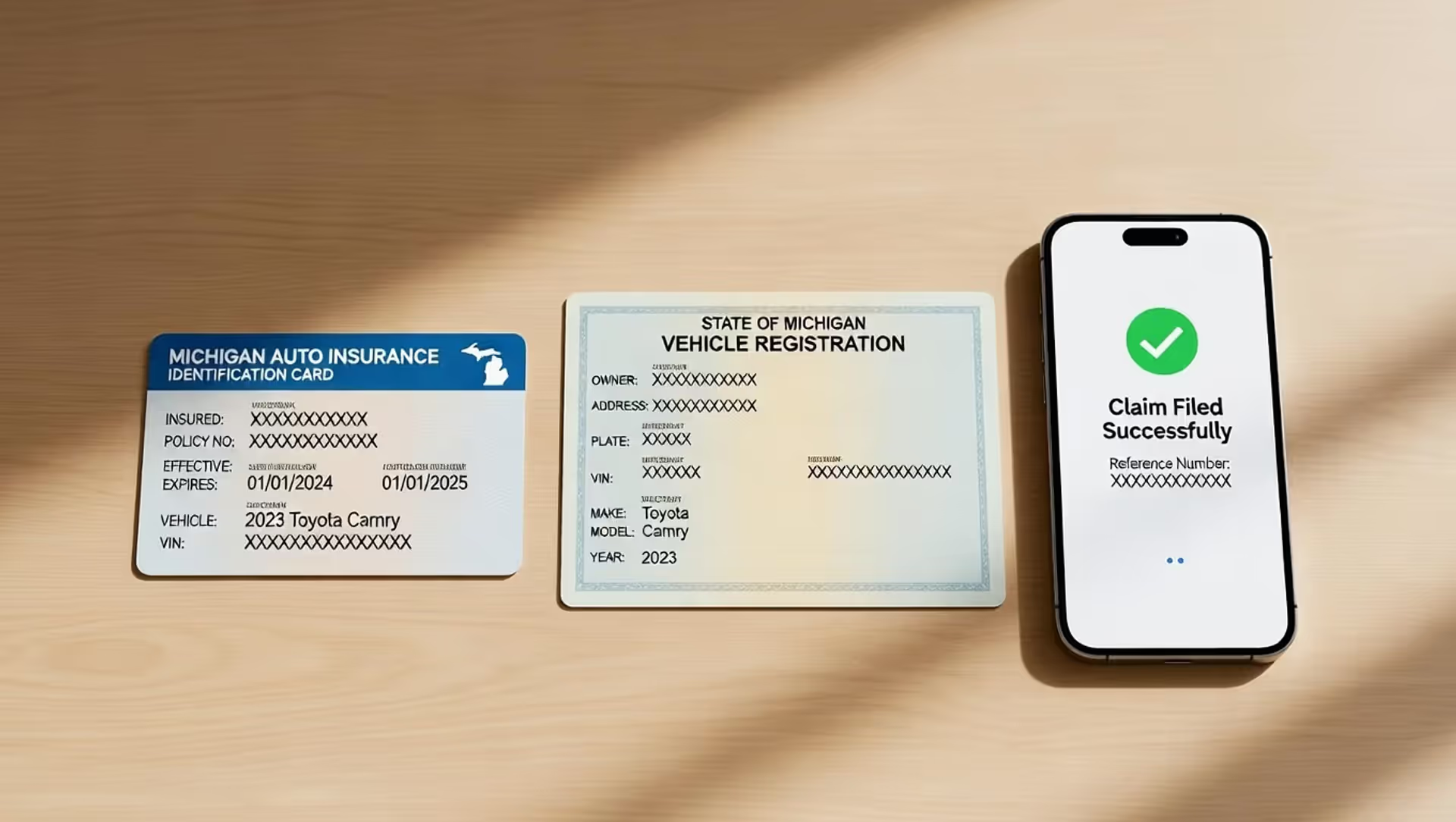
Georgia accepts old-school paper insurance cards and digital versions on your phone. O.C.G.A. § 40-6-10 explicitly authorizes electronic proof, though you might encounter officers who don't realize this—stand your ground politely.
You'll need to show proof during:
Traffic stops: Every single one. Speeding ticket, broken taillight, DUI checkpoint, random stop—officers request license, registration, and insurance proof immediately.
Vehicle registration: County tag offices require proof before processing new registrations or renewals. Their computers usually auto-verify through Georgia's electronic system, but bring documentation anyway in case their system glitches.
Accident scenes: You must exchange insurance information with other drivers involved. Even if you're clearly not at fault, refusing to provide proof can result in citations.
Random audits: Georgia randomly mails verification requests requiring proof within 30 days. These aren't scams—they're legitimate compliance checks. Ignore them and face automatic suspension.

Author: Brandon Whitaker;
Source: trialstribulations.net
Acceptable documentation includes physical ID cards from your insurance carrier, your insurer's mobile app showing active policy details, or declaration pages listing current coverage dates. Screenshots work if they clearly display your name, policy number, and effective dates. Expired cards don't count, even if your policy renewed—you need current proof.
Just bought a new policy? Most insurers provide temporary proof immediately via email or printed document. Keep this in your vehicle until permanent cards arrive in the mail, usually within 7-10 days.
Switching insurance companies creates coverage gap risks. Make certain your new policy starts before canceling the old one. Even one day without active coverage violates Georgia law and triggers the electronic system's alarms.
Common Mistakes Georgia Drivers Make With Car Insurance
Plenty of Georgia drivers think insurance is like vehicle registration—something you need once to get your tags, then forget about. Wrong. Georgia's electronic monitoring system catches coverage lapses within days, generating suspension notices that blindside drivers who thought they were done with insurance after registration.
Another expensive mistake: assuming the 25/50/25 minimums will actually protect you. They won't. A driver blows through a stop sign and T-bones your Tahoe, totaling it ($45,000) while injuring you and your spouse. Their policy covers injuries up to $50,000 total—split between both of you—and property damage up to $25,000. Your vehicle alone exceeds their property damage limit by $20,000. Unless you carry underinsured motorist coverage, you're eating that difference.
Moving creates insurance headaches drivers don't anticipate. Shift from rural Valdosta to Atlanta? Your premiums might double based purely on ZIP code. Accident rates, theft statistics, and repair costs vary wildly across Georgia. Failing to update your address with your insurer might invalidate your coverage entirely or constitute fraud if you're deliberately claiming a cheaper address.
Policy lapses for non-payment happen constantly. Auto-pay fails. Mail gets lost. Life gets hectic. Your insurer cancels coverage, often with minimal warning beyond a mailed notice you didn't see. Georgia's system detects the cancellation within days. Fixing it requires paying back premiums, reinstatement fees, potentially SR-22 filing fees, and sometimes higher rates due to the lapse.
Many drivers fundamentally misunderstand liability coverage limitations. Liability pays for damage you cause OTHER people—not your own vehicle or injuries. You cause a crash? Your liability insurance fixes the other guy's car and pays their medical bills. Your smashed-up vehicle? That's on you unless you carry collision coverage. Your injuries? You need medical payments coverage or health insurance. Drivers with liability-only policies end up shocked when insurers refuse to fix their vehicles after at-fault crashes.
Additional Coverage Options Beyond Georgia's Minimum Requirements
Georgia mandates only liability coverage. That's the bare legal minimum. Smart drivers add protection addressing the state's high uninsured driver rate and the glaring inadequacy of minimum limits.
Uninsured/Underinsured Motorist Coverage (UM/UIM): Optional coverage protecting you when hit by drivers with no insurance or insufficient coverage. With 12% of Georgia drivers operating uninsured—one in eight vehicles—UM/UIM becomes essential rather than optional. It covers your medical expenses, lost income, and vehicle damage when at-fault drivers can't pay. UM/UIM can match or exceed your liability limits. Many insurance agents recommend $100,000/$300,000 in UM/UIM coverage minimum.
I see Georgia clients regularly whose medical bills hit $100,000 or more after crashes with minimally-insured drivers. Those drivers carried Georgia's required $25,000 per person, which doesn't make a dent in serious injuries. Without underinsured motorist coverage, my clients cover the difference from their own pockets—or go bankrupt trying.
— Michael Patterson, Personal Injury Attorney, Patterson & Associates, Atlanta
Collision Coverage: Pays for your vehicle repairs after crashes regardless of who caused them. Particularly valuable if you're driving a newer vehicle or still making loan payments. Lenders typically mandate collision coverage. You'll pay a deductible first—usually $500 or $1,000—then insurance covers the remaining repair costs.
Comprehensive Coverage: Covers non-crash damage like theft, vandalism, hail damage, fallen trees, deer strikes, and fire. Georgia's severe weather—including intense hailstorms and occasional tornadoes—makes comprehensive coverage worth considering. Like collision, you'll pay a deductible before coverage kicks in.
Medical Payments Coverage (MedPay): Covers your medical expenses after crashes regardless of fault, paying for ambulance transport, emergency room treatment, surgery, and follow-up appointments. MedPay bridges the gap between your crash date and when health insurance processes claims. It's cheap—often $50-$100 annually for $5,000-$10,000 in coverage.
Rental Reimbursement: Covers rental car costs while your vehicle sits in the body shop. Without it, you're paying $40-$60 daily out-of-pocket for potentially weeks while repairs drag on.
Roadside Assistance: Provides towing, battery jumps, flat tire changes, and lockout service. Not crash-related, but prevents situations where you're stranded and tempted to drive an unsafe vehicle home.
The price difference between minimum coverage and comprehensive protection surprises many drivers. Jumping from Georgia's 25/50/25 minimum to 100/300/100 liability plus UM/UIM, collision, and comprehensive typically adds $50-$150 monthly depending on your driving record, vehicle, and location. That extra cost prevents catastrophic financial loss after serious crashes.
Frequently Asked Questions About Georgia Car Insurance Laws
Understanding Your Responsibilities Under Georgia Law
Georgia's insurance laws create a bare-minimum safety net—not a recommendation for what you should actually carry. Medical expenses, vehicle replacement costs, and lawsuit judgments have exploded since legislators set these minimums, making them inadequate for many crashes.
Driving legally in Georgia means maintaining active coverage continuously, carrying proof constantly, and understanding your obligations after crashes. The state's electronic monitoring system and escalating penalties make insurance compliance mandatory, not optional. One lapse triggers suspensions, fines, and potentially years of SR-22 requirements.
More critically, adequate coverage protects your financial future. Georgia's high uninsured driver percentage and fault-based liability system create substantial risks. Carrying only liability minimums leaves you exposed when uninsured drivers hit you or when you cause crashes exceeding your policy limits. The modest monthly difference between minimum and comprehensive coverage pales in comparison to potential financial devastation from one serious crash.
Review your policy every year. Confirm it reflects your current address, household members, and vehicles accurately. Consider increasing liability limits to $100,000/$300,000/$100,000 minimum. Add uninsured motorist coverage matching your liability limits. Evaluate whether collision and comprehensive coverage justify their cost for your vehicle's current value.
Georgia's insurance laws exist to protect every road user. Understanding and exceeding these requirements protects you, your passengers, and other drivers while ensuring legal compliance in a state that actively enforces insurance regulations through automated monitoring systems.