A single lapse in coverage can trigger immediate consequences
Missouri Car Insurance Laws Guide to Requirements Penalties and Compliance

Content
Last month, my neighbor found out his insurance had expired when he tried renewing his registration online. The system just... stopped. Wouldn't let him proceed. Turned out his auto-pay failed three weeks earlier, and Missouri's database had already flagged his vehicle. Cost him $220 in fees and an SR-22 filing that'll keep his rates jacked up for the next two years. All over a declined credit card he didn't notice.
Here's what catches people off-guard about Missouri's approach: you're either covered or you're suspended. There's no middle ground, no warning emails, no phone calls asking if you meant to let your policy lapse. The state runs its insurance verification system on autopilot. Once that system registers a gap in coverage—whether it's three months or three hours—the suspension machinery starts rolling.
Missouri also operates as a fault state, meaning whoever causes the wreck pays for the damage. Your insurance company doesn't automatically cover your medical bills like in no-fault states. Instead, if someone rear-ends you at a stoplight, their liability policy handles your hospital visit. If you're the one who wasn't paying attention? Your liability coverage better be high enough, because Missouri courts will let injured parties come after your personal assets when your policy maxes out.
The verification system Missouri uses cross-references DMV records with insurance company filings every quarter. Miss a single day of coverage during one of those sweeps and you'll get a letter demanding proof of insurance within 30 days. Ignore it or can't provide documentation? Your license and plates get suspended automatically. No hearing, no review by an actual person—just computer systems talking to each other and deciding you're off the road.
I'm walking you through Missouri's specific coverage requirements, how they stack up against surrounding states, what actually happens when enforcement catches up with you, and how the state's fault system determines who cuts checks after a crash.
What Coverage Does Missouri Require for Drivers?
State law (Missouri Revised Statutes Section 303.190) sets three baseline liability numbers every driver must carry:
- $25,000 bodily injury per person – Covers medical treatment, lost paychecks, rehabilitation, and pain/suffering damages when you injure someone
- $50,000 bodily injury per accident – The maximum your insurer pays when multiple people get hurt in one collision
- $25,000 property damage – Pays for vehicle repairs plus anything else you demolish (fences, storefronts, highway guardrails, someone's prized landscaping)
Think of these as the absolute minimum before you start breaking state law, not as sensible protection levels. Rear-end a three-year-old Ford F-150? Average repair estimate runs $8,500 for moderate damage. But clip a new Rivian or Tesla? You're looking at $40,000+ in parts and labor before anyone's even discussed rental car costs or diminished value claims. That $25,000 property limit evaporates fast.
Medical costs get ugly faster. Break someone's femur and you're facing $35,000 in surgical costs alone, before physical therapy or follow-up appointments. Your $25,000-per-person limit won't cover the first month of treatment.
What Missouri law doesn't require you to buy:
- Collision coverage (fixes your vehicle after crashes)
- Comprehensive coverage (theft, hail damage, hitting a deer, vandalism)
- Medical payments coverage (your own injury expenses after accidents)
- Uninsured motorist protection—though there's a catch here
Every insurance carrier licensed in Missouri must offer you uninsured/underinsured motorist coverage matching whatever liability limits you choose. You can decline it, but they'll make you sign paperwork acknowledging you rejected the protection. Worth noting that roughly one in eight Missouri drivers operates without any coverage whatsoever. When an uninsured driver T-bones your vehicle and puts you in the ER, you're either suing someone who probably can't pay, or you're eating every dollar of those costs yourself.

Author: Tara Livingston;
Source: trialstribulations.net
How Missouri's Minimum Coverage Compares to Neighboring States
Missouri's 25/50/25 requirements land right in the middle when you compare them to the seven states sharing borders. Check out how the minimums break down:
| State | Bodily Injury (Per Person) | Bodily Injury (Per Accident) | Property Damage |
| Missouri | $25,000 | $50,000 | $25,000 |
| Illinois | $25,000 | $50,000 | $20,000 |
| Kansas | $25,000 | $50,000 | $25,000 |
| Arkansas | $25,000 | $50,000 | $25,000 |
| Iowa | $20,000 | $40,000 | $15,000 |
| Nebraska | $25,000 | $50,000 | $25,000 |
| Tennessee | $25,000 | $50,000 | $15,000 |
| Oklahoma | $25,000 | $50,000 | $25,000 |
Iowa sets the lowest bar—their $15,000 property damage minimum might've made sense in 2004, but today's average vehicle transaction price hovers around $38,000. Tennessee also caps property requirements at $15,000, which won't fully cover a base-model Toyota Highlander.
Missouri matches Kansas, Arkansas, Nebraska, and Oklahoma exactly at 25/50/25. Illinois requires slightly less property coverage at $20,000. The consistency makes cross-border driving simpler, though none of these minimums provide what I'd call robust protection. Insurance Information Institute data from 2023 pegged average bodily injury claim payouts at $23,400, with property damage averaging $5,600. Those numbers work fine until you collide with two vehicles, injure a passenger with serious medical needs, or damage a vehicle less than five years old.
Your Missouri policy functions in all 50 states. Drive to North Carolina or Oregon and your coverage remains active during accidents there. The complication: states with higher minimums than Missouri might consider your policy inadequate even though it's technically legal. Alaska requires 50/100/25 coverage. Your 25/50/25 Missouri policy won't get you ticketed there, but Alaska courts could reference their higher thresholds when calculating appropriate compensation in serious injury cases.

Author: Tara Livingston;
Source: trialstribulations.net
Penalties for Driving Without Insurance in Missouri
Missouri's Motor Vehicle Financial Responsibility Verification Program runs automated insurance checks every 90 days, matching carrier databases against vehicle registrations. Your coverage expires February 28th at midnight. By late March, the state computer flags your registration. There's no caseworker reviewing your situation or considering whether you had a good reason. The system automatically generates a suspension notice.
First violation timeline:
- Day 0: Insurance cancels or expires
- Days 15-45: Department of Revenue mails a notice giving you 30 days to show proof of current coverage
- Day 45: Failure to respond triggers automatic suspension of your license and registration
- Cost: $20 suspension fee plus $200 to reinstate
You'll also need SR-22 certification, which is basically a form your insurance company files with the state confirming you're maintaining continuous coverage. The filing itself costs $15-$50 depending on your insurer. But here's where it really hurts: that SR-22 flags you as high-risk for a minimum two-year period. Insurance companies view coverage gaps as predictive of future lapses, so premiums typically jump 35-80%. Some carriers won't write policies for SR-22 customers at all, forcing you into high-risk insurance markets where minimum coverage easily runs $150-$200 monthly instead of the $45-$60 you were paying before.
Second violation within five years:
- $400 reinstatement fee (doubled from first offense)
- Another two-year SR-22 period that starts over from scratch
- Up to 15 days in county jail if police catch you driving on that suspended license
Third violation:
- Maximum one year in jail
- $500 fine
- Vehicle impoundment with daily storage fees piling up
Judges don't usually impose maximum sentences for what's technically an administrative violation, but getting arrested for driving-while-suspended converts a paperwork headache into a criminal misdemeanor on your permanent record. Missouri State Highway Patrol arrests roughly 8,000 drivers every year for operating vehicles with insurance-related suspensions.
The most expensive mistake people make isn't deliberately skipping insurance—it's the gap between policies. Your State Farm coverage expires April 30th, your new Farmers policy starts May 1st, and that single overnight gap sets off the entire suspension chain. Always start new coverage one day before the old policy expires, then cancel the old one and collect your prorated refund. Five minutes of planning saves months of bureaucratic nightmare.

Author: Tara Livingston;
Source: trialstribulations.net
Who Pays After an At-Fault Accident in Missouri?
Missouri uses a traditional tort system where the driver who caused the collision—or more accurately, their liability insurance company—compensates everyone who got hurt. Police reports establish fault through witness statements, traffic citations, physical evidence like skid marks or vehicle damage patterns. Disputed cases sometimes need accident reconstruction experts who analyze momentum calculations and crush damage to determine who did what.
Common scenario: You're scrolling Instagram at a red light, don't notice it turn green, and roll forward into the Honda ahead. The other driver complains of neck stiffness and visits an ER that bills $4,200 for X-rays and a cervical collar. Their rear bumper needs $3,800 in bodywork. Your bodily injury liability handles the $4,200 medical bill, property damage liability covers the $3,800 repair—both well under your 25/50/25 limits. Damage to your own vehicle and any injuries you sustained? Not covered unless you bought collision and medical payments protection as add-ons.
Different scenario: An uninsured driver blows through a stop sign and T-bones your driver's door. You rack up $12,000 in medical costs and $8,000 vehicle damage. If you maintained the uninsured motorist coverage your insurer offered when you signed up, that UM coverage pays both amounts up to your UM limits. Your insurance company then goes after the at-fault driver through subrogation—essentially suing them on your behalf to recover what they paid out. Without UM coverage, you're filing that lawsuit personally and trying to collect from someone who couldn't manage $50 monthly insurance premiums. Good luck with that.
Missouri also applies comparative fault principles. Say you're doing 50 mph in a 40 mph zone when another driver turns left across your path without yielding. A jury determines you're 25% responsible for speeding while the other driver carries 75% blame for the illegal turn. Your total damages hit $80,000. You'd recover 75% of that—$60,000—because your speeding contributed to how bad the crash turned out. Missouri only bars recovery when your fault exceeds 50%. Cross that line and you collect nothing no matter how negligent the other driver was.
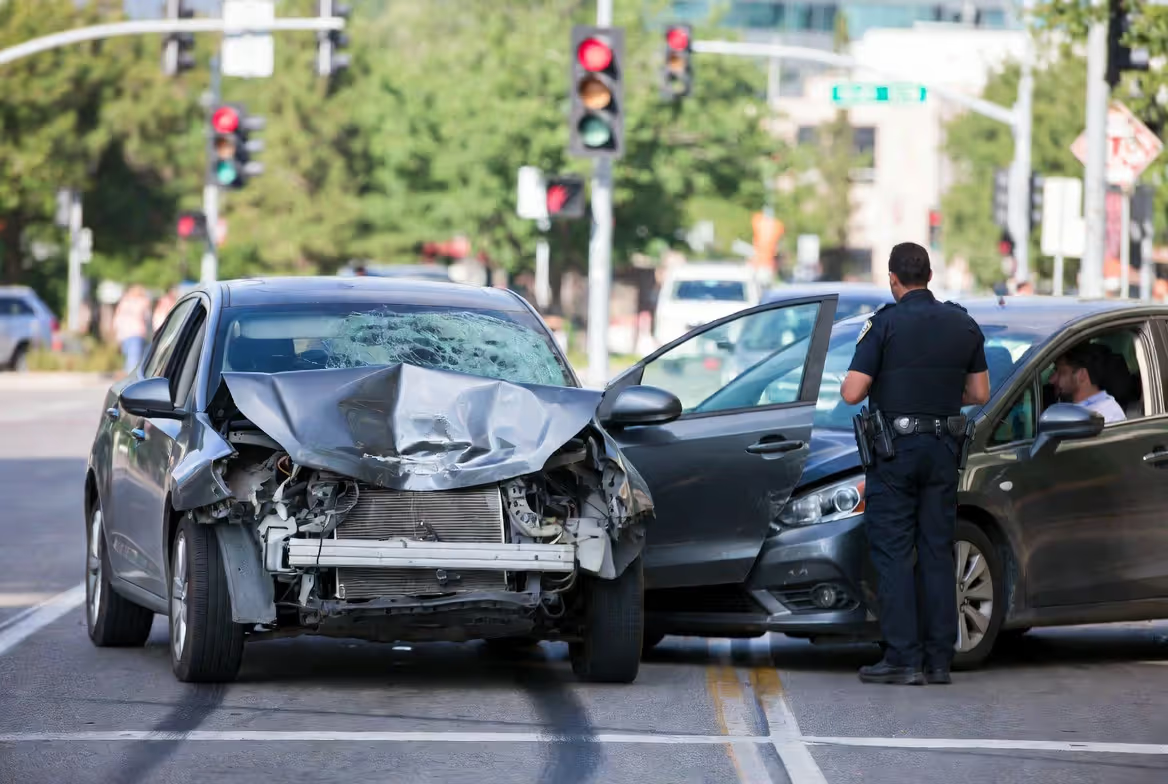
This fault-based framework makes liability limits genuinely important. Cause a crash generating $200,000 in damages while carrying only Missouri's $50,000 bodily injury minimum? The injured person can sue you personally for that $150,000 gap. Missouri courts authorize wage garnishment up to 25% of your disposable income. Banks must comply with account levies. Homeowners face property liens that attach to equity and come due at sale. Bankruptcy doesn't easily discharge accident judgments, so one catastrophic crash can haunt your finances for decades.
Author: Tara Livingston;
Source: trialstribulations.net
Five Factors That Raise Your Premiums in Missouri
Missouri doesn't regulate insurance pricing the way some states do—companies develop their own rate formulas using actuarial models the Department of Commerce and Insurance reviews and approves. Five factors consistently drive costs upward:
1. Credit-based insurance score
Missouri law allows insurers to adjust premiums based on your credit history. Someone with a 580 FICO score pays 65-110% more than an identical driver with a 780 score, even when both have spotless 10-year driving records. Insurance companies defend this using actuarial studies showing statistical correlation between credit management and claim frequency across millions of policies. Consumer advocates call it economic discrimination that punishes people for medical debt or student loans. Whatever your opinion, if your credit score sits below 620, get quotes from at least five carriers—regional insurers like Shelter or Missouri Farm Bureau sometimes weight credit factors less heavily than Progressive or Allstate.
2. Where you park overnight
Garage your vehicle in Kansas City's 64108 ZIP code (downtown core) and your premium runs 40-60% higher than nearly identical coverage in 65010 (rural Cole County). Cities concentrate vehicle theft, vandalism, hit-and-runs, and intersection collisions. St. Louis sees the steepest premiums in ZIP codes 63106 and 63107, where uninsured motorist rates exceed 18% and vehicle theft claims run triple the state average. Move 25 miles outside the city and you'll cut your annual bill $300-$600 on identical coverage limits.
3. Your driving record over the past three to five years
Most Missouri insurers pull three years of history, though some examine five years for serious violations. One at-fault accident raises rates roughly 38-45% for three policy terms. DUI convictions trigger 90-160% surcharges and require SR-22 filings. Speeding tickets matter, but context counts—getting clocked at 12 mph over adds 8-12%, while 25 mph over or reckless driving hits you for 25-35%. Parking citations don't affect rates. Worth noting: appear in court and negotiate with prosecutors before your date. Many will reduce a 20-over speeding charge to "defective equipment" or another non-moving violation that keeps points off your license and leaves insurance rates untouched.
4. What coverage you select and which deductibles you choose
Basic liability meeting Missouri's minimums costs $420-$680 annually for a 40-year-old driver with clean history in mid-sized cities like Springfield or Columbia. Add collision with a $500 deductible, comprehensive with $250 deductible, and boost liability to 100/300/100? Now you're paying $1,350-$2,100. The cost gap narrows as vehicles age—adding full coverage to a 2014 sedan worth $5,200 might only add $340-$480 yearly. General guideline: when your annual collision and comprehensive premiums hit 10% of the vehicle's actual cash value, you're basically self-insuring. Drop the physical damage coverage and bank those savings.
5. Vehicle theft rates and repair costs specific to your make/model
Vehicle rating is fundamentally about predicting future losses based on past performance. A sports car with 400 horsepower and a theft rate three times the national average will always command higher premiums than a family sedan with advanced safety features and minimal theft risk.
— Robert Hunter, Director of Insurance, Consumer Federation of America
Older Honda Accords and Civics dominate Missouri's most-stolen list because their parts fit dozens of model years and lack modern anti-theft immobilizers. Dodge Chargers and Challengers rank high because thieves want powerful vehicles and parts demand stays strong. Insurers charge 20-40% more for comprehensive coverage on theft-prone models. High-performance vehicles and luxury brands cost more because replacement parts run expensive and body shops charge premium labor rates. The upside: three-row SUVs, minivans, and midsize sedans with top IIHS safety ratings earn 10-20% discounts. Vehicles equipped with automatic emergency braking, adaptive cruise control, and blind-spot monitoring qualify for additional safety technology discounts at most companies.

Author: Tara Livingston;
Source: trialstribulations.net
How to Prove Compliance During Traffic Stops and Registration
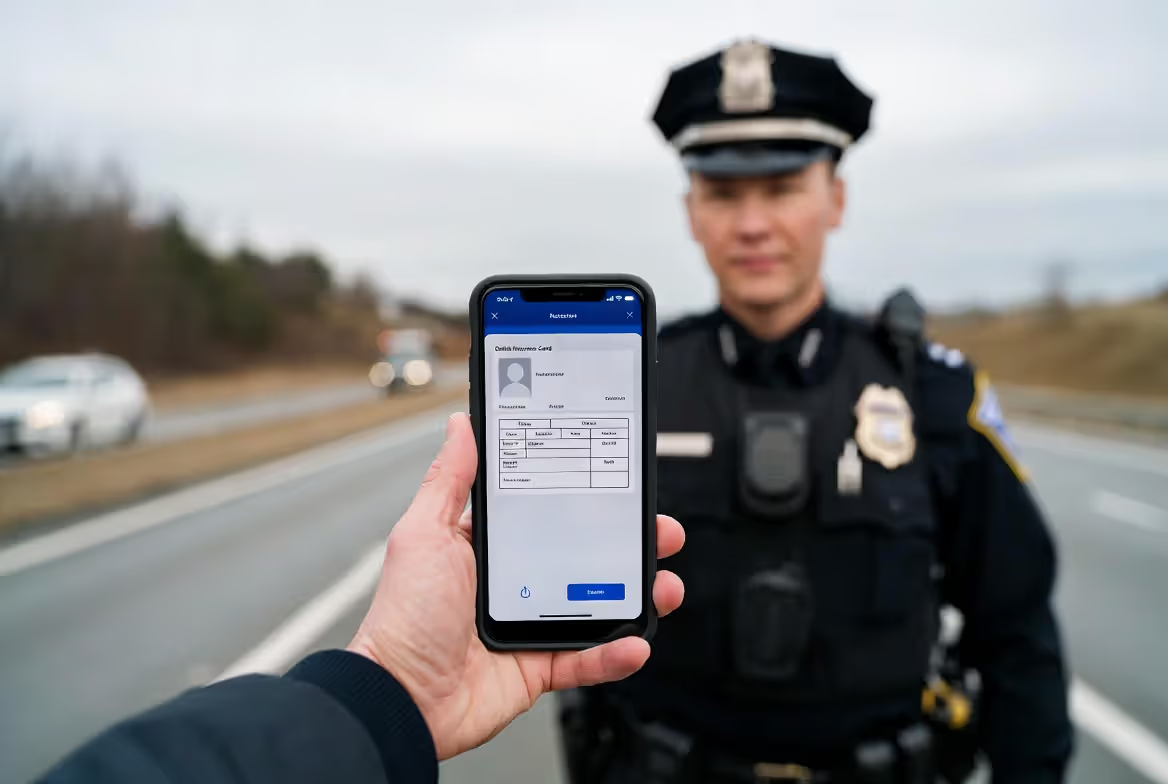
Missouri Revised Statutes Section 303.024 requires drivers to produce proof of insurance when officers request it or when renewing vehicle registration. State law accepts three formats:
- Traditional paper insurance cards your company mails quarterly
- Digital proof displayed on your smartphone screen
- PDF copies or email confirmations stored in your device
Officers can't confiscate or physically handle your phone to verify the information—you display the screen showing your policy number and effective dates, they record what they need, everyone moves on. Keep a screenshot saved to your camera roll or a PDF in a dedicated folder. Fumbling through Gmail at 11 PM during a traffic stop while rain pelts your windshield tests everyone's patience.
Registration renewal process: Missouri's online renewal system queries the verification database automatically. Coverage confirmed? Your registration renews instantly. System can't verify active insurance? You'll need to upload a declarations page or contact your insurer to update their filing with the Department of Revenue. Attempting renewal without verified coverage fails immediately. Driving with expired tags invites a citation and possible towing if you can't provide current registration documents.
Author: Tara Livingston;
Source: trialstribulations.net
What happens during lapses: When your insurer cancels coverage mid-term—for non-payment, fraud, excessive claims, whatever the reason—they notify Missouri within 10 business days. You've got 30 days to reinstate that policy, switch to a replacement carrier, or surrender your plates to the DMV. Surrendering plates doesn't erase the suspension; it pauses the registration but leaves the license suspension active. Register another vehicle later and you're still paying that reinstatement fee plus filing a new SR-22.
Practical tip that'll save you headaches: set a phone reminder for one week before your policy renews. Log into your insurer's portal and confirm they've processed your payment and coverage continues without interruption. Automatic payment failures from expired credit cards or insufficient checking account balances cause more accidental lapses than any other single factor. Takes 90 seconds to verify and saves you weeks of bureaucratic hassle.
Frequently Asked Questions About Missouri Car Insurance Laws
Missouri's insurance framework prioritizes making sure injured people can collect compensation and keeping financially irresponsible drivers off the road. The state gives you freedom to purchase higher limits or better coverage, but those baseline 25/50/25 requirements aren't negotiable. Electronic monitoring eliminated the era when drivers could skip insurance for months without consequences—the system flags lapses within weeks, and penalties compound faster than most people expect.
The costliest mistake isn't deliberately driving uninsured. It's letting coverage lapse during transitions—switching insurers, moving between apartments, or experiencing payment processing glitches that create gaps costing hundreds in fees and years of elevated premiums. Set calendar reminders, always overlap new coverage before canceling old policies, and verify your insurer has updated the state database after making changes.
If you're riding Missouri's minimums because they're cheap, understand what you're risking. One serious accident can expose you to lawsuits exceeding your coverage by $100,000 or more. Bumping liability limits to 100/300/100 costs an extra $240-$480 yearly for most drivers—cheap protection against wage garnishment or property liens. Uninsured motorist coverage, though technically optional, protects you when the at-fault driver has no coverage or flees the scene. Missouri roads carry enough risk without betting your financial future on whether other drivers followed the same laws you did.