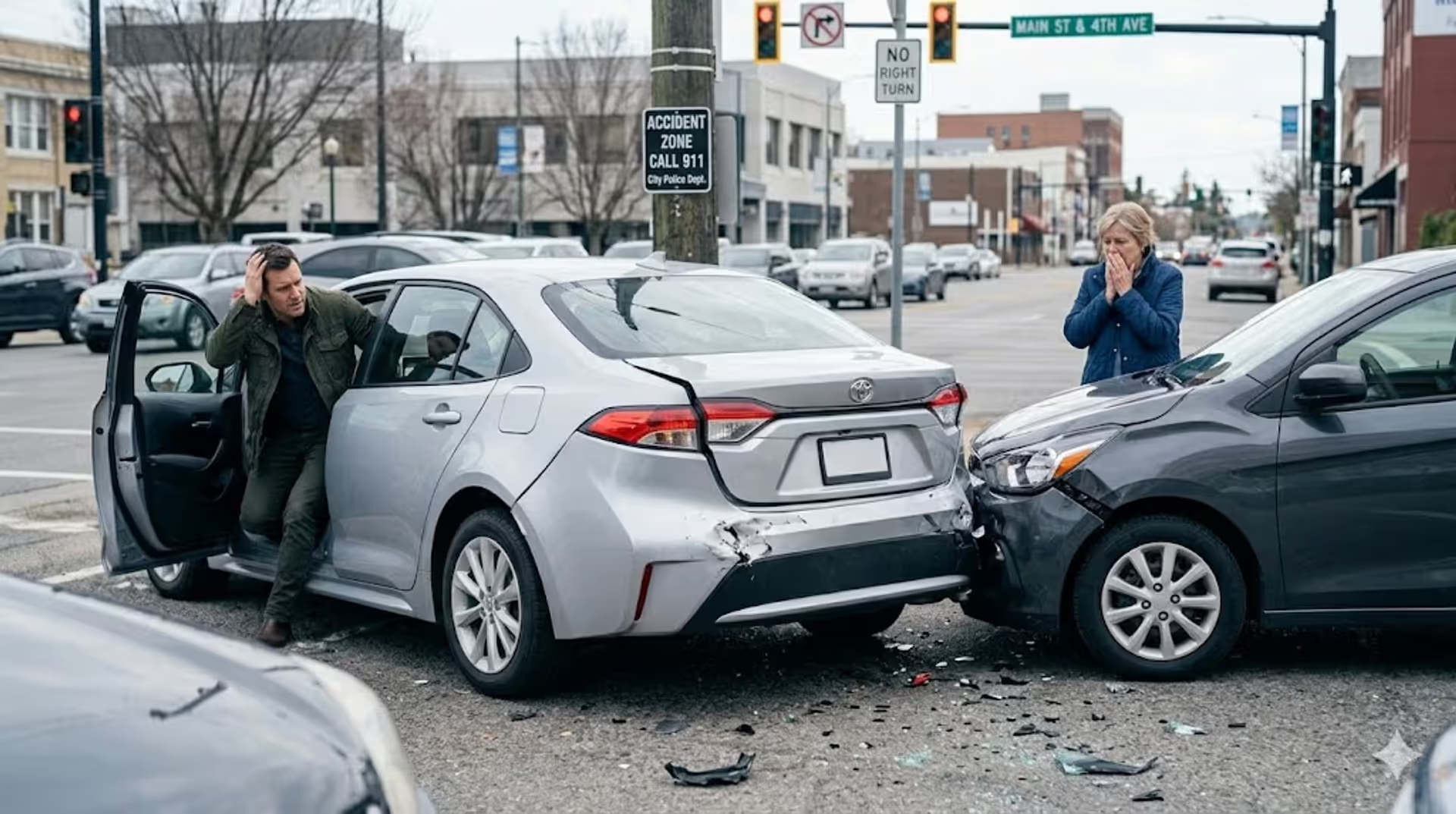
car accident at intersection with drivers inspecting damage
Stacked vs Unstacked Insurance Explained for Your Auto Policy

Content
Red light. You've stopped. Thirty seconds later, a Honda Civic plows into your bumper at 35 mph. The driver stumbles out, hands shaking, already apologizing. Then comes the gut punch: "I don't have insurance—I couldn't afford to renew it last month." Your car needs $8,000 in bodywork. Your back injury? That's looking like $40,000 once you factor in the surgery your orthopedist is recommending.
Who's writing those checks?
This exact scenario is why uninsured motorist coverage exists on your policy. But here's the part that catches people completely off guard: depending on how your policy is structured, you might be looking at $50,000 in available coverage, or you might have $150,000. Same household, identical vehicles, wildly different protection levels.
Whether you chose stacked or unstacked coverage determines your actual protection when some broke driver totals your car and your lower back. Too many drivers check a box during signup without understanding what they bought—then figure it out while arguing with a claims adjuster.
What Insurance Stacking Actually Means for Your Policy
You've insured multiple cars. Each one carries its own uninsured motorist limit on your declarations page. Here's where it gets interesting: stacking means combining those separate limits into one larger pool you can tap when disaster strikes. Skip stacking, and you're limited to one vehicle's coverage amount regardless of how many cars sit in your driveway.
Imagine insuring three vehicles with $50,000 in UM protection on each. Go the unstacked route, and $50,000 is your ceiling—period. Doesn't matter that you're paying premiums on three separate vehicles. Switch to stacked? Now you're working with $150,000 total because you've combined all three vehicles' limits.

Author: Calvin Prescott;
Source: trialstribulations.net
Coverage stacking comes in two distinct flavors. Horizontal stacking adds up limits across multiple vehicles living under one insurance policy. Three cars on your State Farm policy? You're tripling your available UM protection through horizontal stacking. Vertical stacking kicks in when multiple separate policies provide you coverage—picture this: you maintain your own Geico policy while also appearing as a named driver on your spouse's Progressive policy. Vertical stacking means you're adding the limits from both completely separate policies.
Real-world example: David insures two cars, each carrying $30,000 in UM coverage. An uninsured driver runs a stop sign and T-bones David's Camry, sending him to the ER. Surgery and six weeks of physical therapy rack up $55,000 in medical bills. His unstacked policy caps out at $30,000, leaving him scrambling to cover the remaining $25,000 from savings. Had David opted for stacked coverage? He'd have accessed $60,000 in benefits—more than enough to handle every bill plus his lost wages.
You're already cutting premium checks for each vehicle on your policy. Stacking simply unlocks access to the full value you're technically already purchasing.

Author: Calvin Prescott;
Source: trialstribulations.net
How Stacked Insurance Multiplies Your Coverage Limits
The calculation is straightforward. Take each vehicle's UM limit, add them together, and boom—that's your total available protection. Simple math. But the financial consequences? Those get serious in a hurry.
| Cars on Policy | Per-Vehicle UM Limit | Unstacked Total Available | Stacked Total Available |
| 1 vehicle | $50,000 | $50,000 | $50,000 |
| 2 vehicles | $50,000 | $50,000 | $100,000 |
| 3 vehicles | $50,000 | $50,000 | $150,000 |
| 2 vehicles | $100,000 | $100,000 | $200,000 |
| 3 vehicles | $100,000 | $100,000 | $300,000 |
Notice what happens without stacking? Adding more vehicles to your policy accomplishes exactly nothing for your UM protection. You're capped at whatever single-vehicle amount your policy states. Stack that coverage, and each additional car dramatically expands your financial safety net.
This multiplication matters most during catastrophic accidents. Severe injuries requiring three surgeries, a two-week hospital stay, and six months away from work can easily punch through $150,000 in costs. When the driver responsible for all that damage carries zero insurance, your UM coverage becomes your only realistic path to recovery. That extra $50,000 or $100,000 from stacking can legitimately prevent bankruptcy.
Naturally, stacked coverage hits your wallet harder. Premiums typically jump 10-40% compared to unstacked alternatives. Currently paying $150 yearly per vehicle for unstacked UM coverage? Stacked coverage might cost $180-210 per vehicle. For a household with two cars, that's roughly $60-120 more annually to double your available protection.
Consider the cost per dollar of actual coverage. Spending 20-30% more in premiums to double your protection ceiling? Pretty solid value—assuming you genuinely need those elevated limits.

Author: Calvin Prescott;
Source: trialstribulations.net
When Unstacked Coverage Makes More Financial Sense
Insure just one vehicle? Stacking provides literally zero value. You cannot multiply a single limit, so you're basically setting money on fire buying a feature that's mathematically impossible to use. Unstacked is your obvious choice.
Maybe you're already carrying enormous UM limits on each vehicle—$250,000 or $500,000 per car. When your existing per-vehicle limit already exceeds what even terrible accidents might cost, stacking just piles unnecessary expense onto your annual bill. A $500,000 unstacked policy likely handles even nightmare scenarios.
Budget realities matter. You're insuring three aging beaters worth maybe $3,000 each, barely affording minimum UM coverage as it stands. That extra $100-200 yearly for stacking might be better spent boosting your per-vehicle limits rather than multiplying inadequate coverage.
Sometimes state law removes your choice entirely. Certain states prohibit stacking under any circumstances, while others make it automatic unless you sign a waiver explicitly rejecting it. Your state legislature might decide this for you.
Let's demolish a popular misconception: "Choosing unstacked means I'm not protected." Completely false. Your unstacked policy still pays the full UM limit printed on your declarations page. You just cannot combine multiple vehicle limits into one massive pot. For many drivers, that single limit delivers adequate protection.
Another widespread mistake: assuming unstacked coverage always delivers superior long-term value. When an uninsured driver hospitalizes you and your bills explode past your unstacked limit, those "premium savings" evaporate instantly. You need to honestly evaluate whether you could stomach a five-figure gap between your coverage and actual costs.
State-by-State Rules That Control Your Stacking Options
Your state legislature dictates whether stacking even exists as an option. Lawmakers and insurance regulators have created a bewildering patchwork of statutes that shift dramatically based on your zip code.
| State | Stacking Permitted? | Key Requirements or Limits |
| Florida | Yes | Insurers offer both options; you must explicitly waive stacking in writing |
| Pennsylvania | Yes | Applies to both UM and UIM; requires specific contract language |
| Ohio | Yes | Included automatically unless your policy specifically excludes it |
| Texas | Yes | Horizontal stacking widely available; vertical stacking faces more restrictions |
| New York | No | State statute prohibits stacking completely |
| California | No | Stacking is illegal throughout the state |
| Illinois | No | Banned with rare exceptions |
| Michigan | No | The no-fault system makes stacking irrelevant here |
| North Carolina | Limited | Specific policy structures allow restricted stacking |
| Georgia | Yes | Must specifically request stacked coverage when purchasing |
| Arizona | Yes | Horizontal stacking permitted; vertical depends on insurer |
| New Jersey | Limited | Availability varies by policy type and insurance carrier |
States allowing stacking generally require insurers to provide both stacked and unstacked options. You select your preference, though stacked coverage occasionally applies by default unless you complete paperwork rejecting it. This creates an odd situation—some drivers pay extra for stacked coverage without realizing it's on their policy.
States banning stacking argue they're keeping premiums affordable for everyone. Insurance companies contend that stacking lets policyholders collect more than their premiums justify, supposedly driving up costs across all customers. Consumer advocates counter that drivers already paid premiums on every vehicle and deserve access to that full purchased value.
The regulatory landscape gets messy fast. Some states permit horizontal stacking while blocking vertical stacking. Others allow it for uninsured motorist coverage but prohibit it for underinsured coverage. A handful of states let individual insurance companies decide, creating wildly inconsistent options even within identical neighborhoods.
Relocate from a stacking-friendly state to one prohibiting it? Your coverage structure transforms the moment you purchase a new policy. You cannot transport your stacked coverage if your new home state doesn't recognize it.
The Real Cost Difference: Premium Increases for Stacked Policies
National averages obscure massive regional variations, but most insurers charge 15-30% more for stacked UM coverage versus unstacked. On a typical policy where UM coverage runs $200-400 annually, stacking adds approximately $30-120 to your yearly bill.
These percentages multiply across your vehicles. A three-car household paying $300 per vehicle for unstacked UM coverage ($900 total) might pay $360-390 per vehicle for stacked coverage ($1,080-1,170 total). That's an additional $180-270 each year to triple your maximum coverage ceiling.
Your driving history affects what you'll actually shell out. Drivers with accidents or speeding tickets already face elevated base premiums, which means their stacking surcharge costs more in actual dollars. Vehicle count matters considerably—insurers price stacking based on the maximum potential claim they might confront.
Your selected coverage limits dramatically affect stacking premiums. Stacking three vehicles carrying $25,000 UM coverage each costs less than stacking three vehicles with $100,000 coverage, despite both scenarios tripling your limits. Higher baseline coverage equals steeper stacking premiums.
Consider a decade-long view. Over ten years, you might spend an extra $2,000 for stacked coverage. Never tap it? That's $2,000 gone forever. One serious accident with an uninsured driver could save you $100,000 in out-of-pocket expenses.
The value proposition shifts based on your profile. Younger drivers statistically crash more frequently, making enhanced protection worth the investment. Got teenage drivers in your household? Stacked coverage deserves genuine consideration. Retired folks driving twice weekly to the grocery store might reasonably skip it.
Different households require different protection strategies. A family with substantial savings might self-insure the gap between unstacked and stacked limits, accepting calculated risk to save on premiums. A paycheck-to-paycheck family cannot absorb a surprise $75,000 medical bill, making stacked coverage essentially mandatory despite the cost.
How to Choose Between Stacked and Unstacked for Your Situation
Begin with a straightforward vehicle count. One car? Unstacked wins by default—you've got nothing to stack. Two or more vehicles? Now stacking becomes worth serious evaluation, though it's not automatically the correct answer for your situation.

Author: Calvin Prescott;
Source: trialstribulations.net
Examine your other insurance policies. Carrying robust health insurance with reasonable deductibles and manageable out-of-pocket maximums? That reduces your dependence on massive UM limits since your health plan handles most medical expenses. Got disability insurance replacing lost wages? That's another financial gap covered by separate protection.
Research your state's uninsured motorist statistics. In states where 20-25% of drivers lack insurance, your probability of needing UM coverage runs considerably higher than in states with only 5-10% uninsured drivers. Elevated risk justifies spending more for superior protection.
Ask yourself honestly: Could you personally absorb a $50,000 medical bill out-of-pocket? If that answer is absolutely not, and you insure multiple vehicles, stacked coverage probably makes sense for your household. If you maintain substantial emergency savings or other insurance policies filling that gap, unstacked might work perfectly fine.
Questions worth posing to your insurance agent:
- What's my precise per-vehicle UM limit, and what total would I access if I stack?
- How much extra would stacked coverage cost me annually across all my vehicles?
- Do you offer discounts that apply specifically to UM coverage?
- If someone else is driving while I'm the passenger when we're hit, how does my stacked coverage work?
- Can I modify my stacking choice at renewal time without penalties?
Common pitfalls include obsessing over premium costs while ignoring coverage value. Saving $150 yearly feels fantastic right up until you're staring at $100,000 in medical bills with only $50,000 in coverage. Another blunder: assuming your cautious driving prevents serious accidents. The uninsured motorist who T-bones you doesn't care about your spotless driving record.
Some people stack their coverage while carrying minimum per-vehicle limits, ending up with stacked coverage that's still woefully inadequate. Three vehicles with $25,000 UM coverage each provides $75,000 total stacked—which still falls painfully short in a serious accident. Better to carry $50,000 or $100,000 per vehicle regardless of your stacking decision.
There's no one-size-fits-all answer here—it's about matching protection to your household's specific risk profile and financial situation. I typically recommend stacked coverage for multi-vehicle families unless budget constraints are truly severe. The modest premium increase buys substantial additional protection precisely when you need it most.
— Robert Chen
Your decision framework distills to these core questions: How many vehicles appear on your policy? Can you financially withstand massive unexpected medical expenses? What's your personal comfort level with risk? What will stacking actually cost you specifically? Reflect on these honestly, and the right choice typically becomes clear.
FAQ: Stacked vs Unstacked Insurance Questions
Selecting between stacked and unstacked insurance hinges entirely on what your household genuinely needs. Multi-vehicle families gain meaningful protection from stacking, particularly when the premium increase stays reasonable compared to the coverage boost. Single-vehicle households save money with unstacked coverage since they literally cannot benefit from stacking.
Your state's regulations might eliminate the choice completely, or they might require you to actively select one option over the other. Regardless, understanding how these two approaches function prevents you from wasting money on coverage you cannot use or leaving yourself dangerously underprotected when an uninsured driver causes substantial harm.
Calculate what your stacked limits would total, compare the premium difference, and honestly assess whether you could handle massive unexpected medical expenses from your own pocket. That analysis reveals which option delivers the right balance of protection and affordability for your specific circumstances. Then review this decision annually—as your household evolves, your insurance needs shift accordingly.