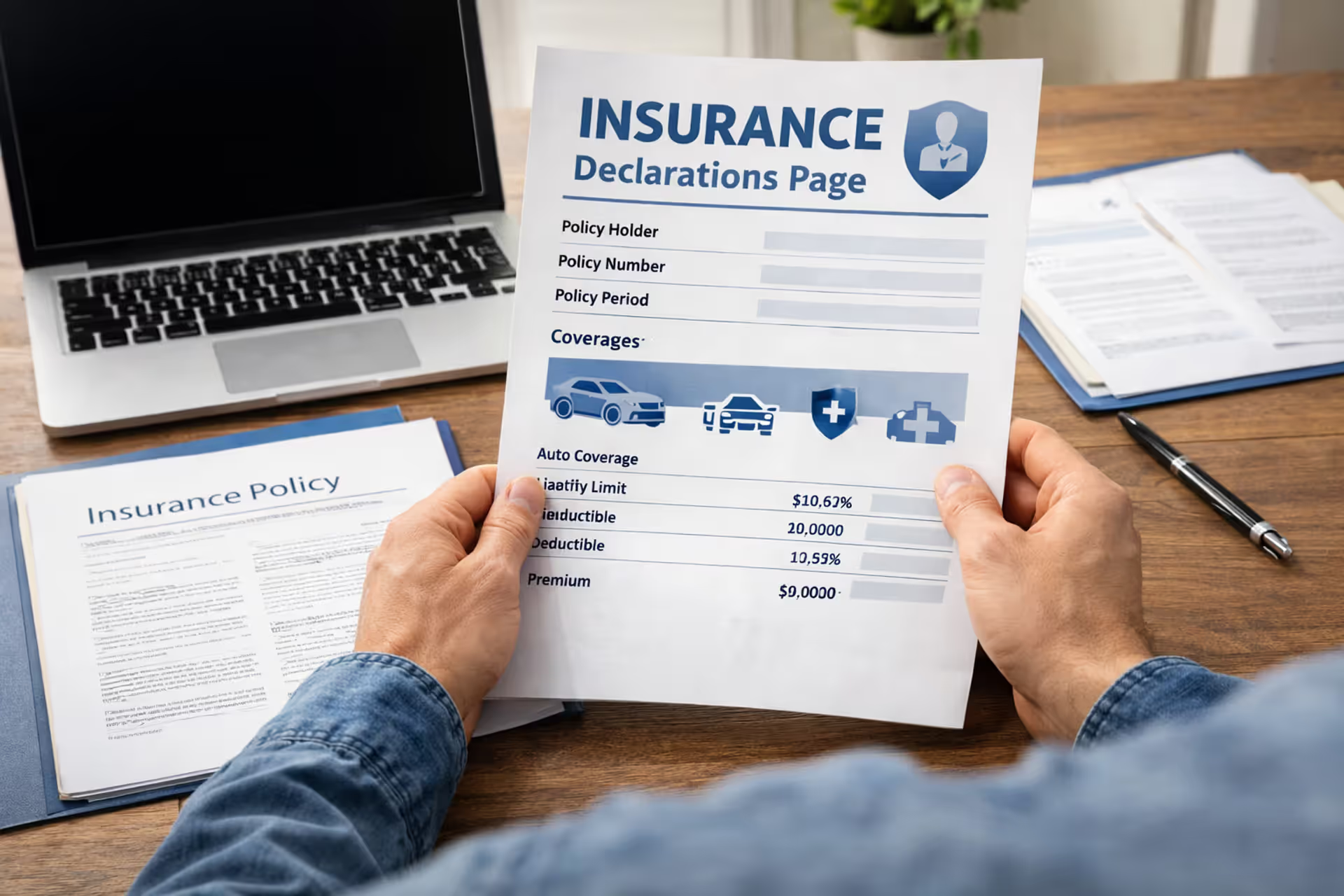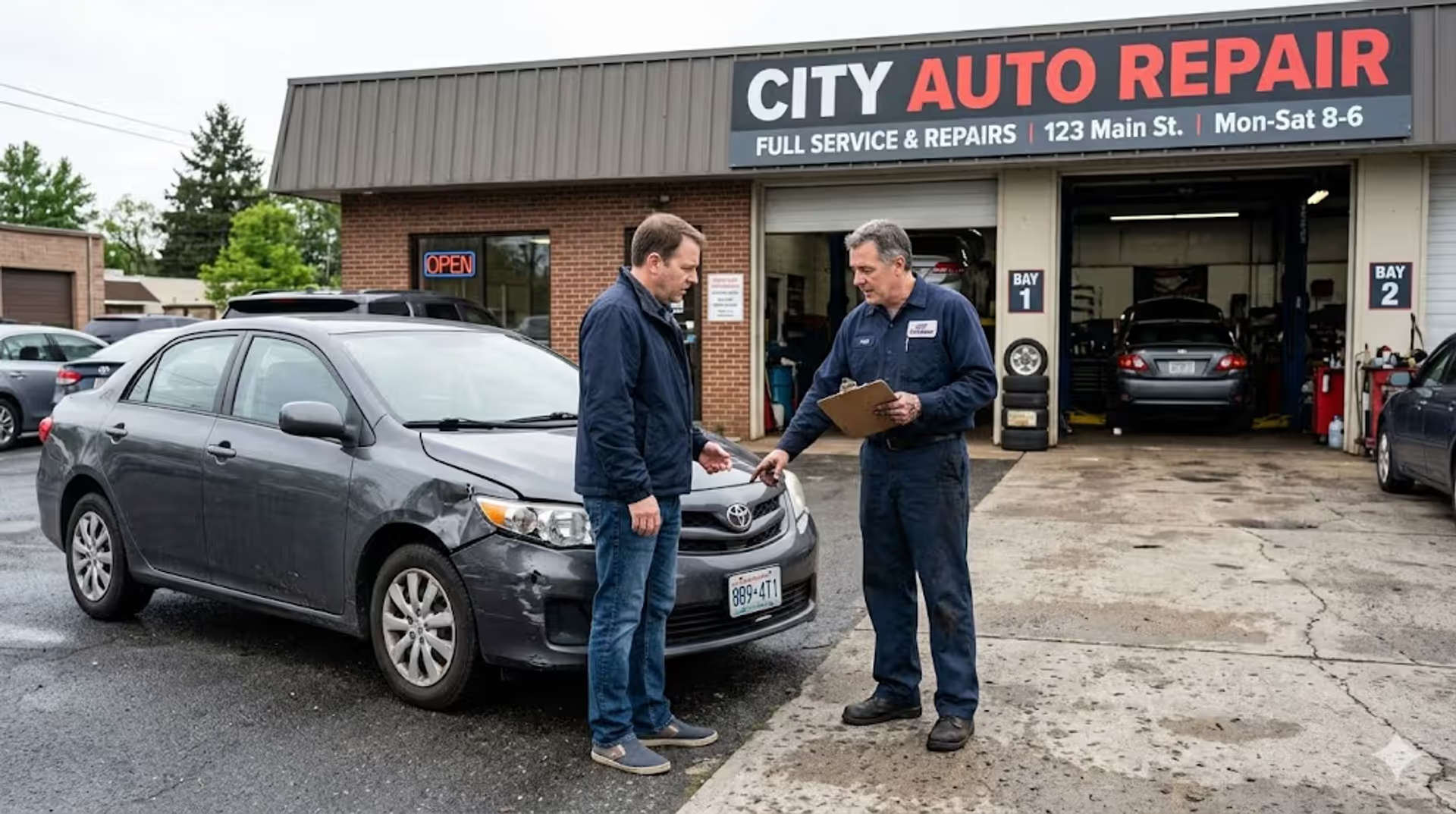
damaged car at repair shop with owner discussing repairs
How Rental Reimbursement Coverage Works on Auto Insurance

Content
Picture this: a distracted driver rear-ends you at a stoplight. Your car's headed to the body shop for three weeks. Meanwhile, you've got a 45-minute commute, groceries to buy, and kids who need rides to soccer practice. Without rental reimbursement coverage, you're either begging friends for rides or watching hundreds of dollars vanish on rental fees.
This particular insurance add-on solves exactly that problem—paying for temporary wheels while yours get fixed after an accident.
What Is Rental Reimbursement Coverage?
Think of rental reimbursement coverage as a financial safety net attached to your car insurance. It's an optional add-on that kicks in when your vehicle needs repairs following a covered incident. Whether you've been in a fender-bender or hail destroyed your windshield, this coverage handles the rental car bill during the repair period.
Here's how it actually works: After filing a claim your insurer approves, you can pick up a rental vehicle and either have the company bill your insurance directly or save your receipts for later reimbursement. The coverage becomes available immediately once your claim gets the green light—no waiting around for adjusters to finish their investigation.

Author: Tara Livingston;
Source: trialstribulations.net
Now, people constantly mix this up with that insurance the rental counter agent tries to sell you. That's completely unrelated. The collision damage waiver at Enterprise or Hertz protects their car if you crash it. Rental reimbursement lives inside your personal auto policy and pays your rental expenses when your car's getting fixed. Two totally different animals.
The fine print matters here. Your coverage only applies to legitimate insurance claims. Normal maintenance won't trigger it—if your alternator dies from old age, you're out of luck. But damage from accidents, weather events, vandalism, or theft? You're covered. Someone steals your Honda, and while the police hunt for it, rental reimbursement puts you in a temporary replacement.
Rental reimbursement fills a critical gap that many drivers don't think about until they're stranded. The average collision repair takes 12 days, and without this coverage, you're looking at $400 to $600 out of pocket for a basic rental—money most people aren't prepared to spend on top of their deductible.
— Sarah Chen
One more distinction worth noting: some insurers use the term "accident transportation coverage" more broadly, potentially covering rideshares or even bus fare. Traditional rental reimbursement specifically means rental cars from actual rental companies. Always check your specific policy wording to know what qualifies.
How to Claim Rental Coverage After an Accident
Getting your rental expenses covered involves a specific sequence. Skip steps, and you might end up paying for that rental entirely yourself.
Step one happens immediately after the accident: call your insurance company. During that conversation, specifically mention rental reimbursement and verify whether your claim qualifies. Your adjuster will confirm approval and spell out your exact limits—how much per day and for how many total days. Never rent a vehicle before this confirmation call. If something goes wrong with your claim, you'll own that entire rental bill.
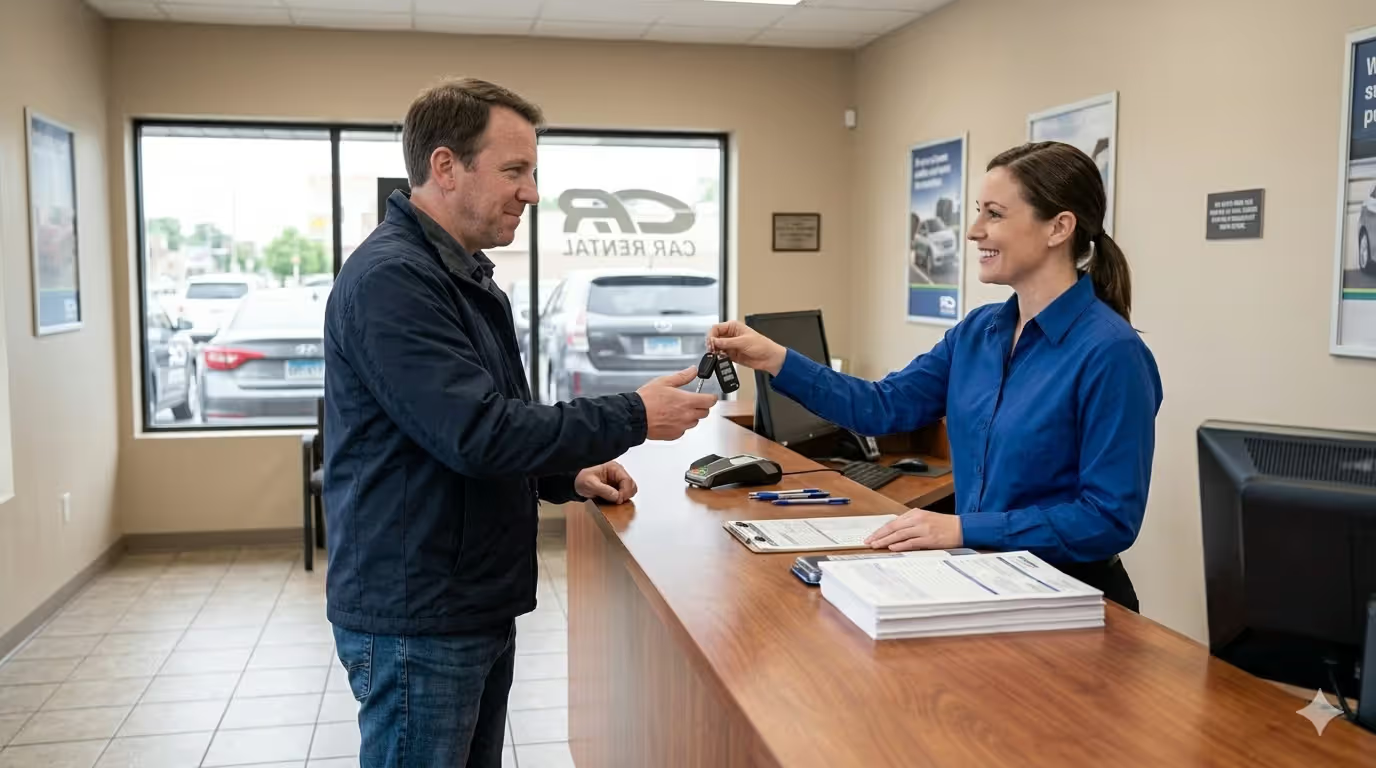
Once approved, grab your claim number and your adjuster's direct contact information. Here's where processes diverge: some insurers partner with specific rental agencies for direct billing, meaning you walk out without paying a cent because they invoice your insurer automatically. Others make you pay first, then reimburse you later after reviewing receipts. Ask which system your company uses before heading to the rental lot.
At the rental counter, choose something comparable to what you normally drive. Daily commute in a Corolla? Don't rent a Tahoe. Your insurer will only reimburse what an economy or mid-size car costs in your market. Keep every single document—the initial rental agreement, daily receipts, any additional charges. If the body shop calls saying they need extra time, get that extension in writing.
Here's a gotcha: most insurance companies require rental returns within one day of repair completion. Your mechanic calls Tuesday afternoon saying your car's ready, but you keep the rental through Friday? Those extra three days come out of your wallet. Stay in regular contact with both the shop and your insurer about timing.
For the reimbursement itself, submit receipts promptly. Processing times vary wildly—some insurers turn them around in under a week, others take nearly a month. If you're using direct billing, double-check with the rental agency that your insurer actually paid before leaving the lot. Billing mistakes happen frequently, and discovering a $600 charge on your credit card three weeks later ruins your day.
Documentation is your insurance policy for the insurance policy. Keep copies of absolutely everything. Snap photos of every receipt with your phone as backup. If disputes arise over dates or dollar amounts, your paper trail protects you.
Author: Tara Livingston;
Source: trialstribulations.net
Understanding Reimbursement Limits and Daily Caps
Here's the math that trips people up: rental reimbursement always includes two numbers—a daily maximum and a time cap. You might see something like $30 daily for up to 30 days, giving you $900 total potential reimbursement. But that doesn't mean you automatically get $900.
Say repairs take 10 days and your rental runs $40 daily. You spent $400 total, but your policy only reimburses $30 per day. Math works out to $300 in reimbursement, leaving you covering that extra $100. Understanding these limits before you need them prevents nasty surprises mid-claim.
Picking the wrong coverage tier costs you either now or later. Too little coverage means out-of-pocket expenses during claims. Too much coverage means wasted premium dollars for protection you'll never use.
Common Coverage Tier Examples
| Daily Limit | Maximum Days | Total Maximum Payout | Typical Annual Premium | Best For |
| $30/day | 30 days | $900 | $15–$25 | People who can borrow a car from family; owners of older vehicles that get repaired quickly |
| $40/day | 30 days | $1,200 | $20–$35 | Average drivers in most U.S. markets; standard repair timeframes |
| $50/day | 45 days | $2,250 | $30–$50 | High rental-cost cities; newer vehicles needing specialized parts or lengthy repairs |
| $75/day | 60 days | $4,500 | $45–$75 | Luxury or exotic car owners; people with zero backup transportation; commercial vehicle needs |
Premium costs jump around dramatically by location. Florida and Michigan residents pay significantly more. Meanwhile, folks in Iowa or Wyoming often pay half those amounts.
What Counts Toward Your Limit
Every calendar day counts, weekends included. Pick up your rental Friday at 3 PM, return it Monday at 9 AM? That's four full days even though the body shop was closed Saturday and Sunday.
Extra charges usually don't qualify for reimbursement. Want GPS navigation or SiriusXM radio in your rental? Your dime. Child safety seats? Also on you. Rental car insurance from the agency—which you probably don't need anyway since your own liability coverage typically extends to rentals—won't be reimbursed either. Gas definitely comes out of your pocket.
Total loss situations sometimes include a grace period. If the adjuster declares your car totaled, you might get an additional 7-10 days of rental coverage beyond the initial assessment, giving you time to shop for a replacement vehicle. But this isn't standard across all policies, so confirm your specific policy's total loss provisions.
Exceeding your limits means paying the difference yourself. Daily rate hits $60 but your limit's $40? You're covering that $20 gap every single day. Repairs stretch to 35 days but your policy stops at 30? Days 31-35 are entirely your financial responsibility, potentially adding $200-300 to your expenses.

Author: Tara Livingston;
Source: trialstribulations.net
Rental Car Insurance Add-On vs. Other Policy Add-Ons
Car insurance companies sell dozens of optional add-ons, and figuring out which ones actually matter for your situation saves money and headaches.
Roadside assistance runs you $10-25 yearly and provides immediate help: towing, battery jumps, lockout service, flat tire changes. It activates instantly when you're stuck on the highway with a dead battery. Rental reimbursement only helps after filing and getting approval for a formal claim. These two work together beautifully rather than competing—one gets you unstuck, the other keeps you mobile during repairs. If both matter to you, buy both.
Gap coverage becomes essential when you're financing or leasing. Let's say you owe $28,000 on your loan but your totaled car's actual value is only $23,000. Gap insurance covers that $5,000 difference, protecting you from owing money on a car you can't drive anymore. This has zero connection to transportation during repairs, but it's crucial if you're underwater on a loan. New car buyers with minimal down payments should prioritize gap coverage. Drivers with paid-off vehicles can ignore it completely.
Accident forgiveness protects your future wallet. After your first at-fault accident, your premiums won't increase. This safeguards your rates down the road rather than providing immediate post-crash help. Great for drivers with spotless records who want rate protection, but it won't put you behind the wheel of anything.
New car replacement coverage pays for a brand new vehicle if your fairly new car gets totaled, instead of just cutting you a check for its depreciated value. Like gap coverage, this addresses the financial loss of the vehicle itself. Driving a new BMW? New car replacement might justify its cost. But rental reimbursement matters regardless of whether you drive a 2024 Mercedes or a 2015 Civic.
Who benefits most from rental reimbursement? Single-car households with long commutes. Parents juggling complicated schedules. Anyone who'd lose their job without reliable transportation. If you own three vehicles, live two blocks from a subway station, or work remotely from home, the value proposition weakens considerably.
Cost Factors: What You'll Pay for This Coverage
Rental reimbursement ranks among the cheapest optional coverages you can buy, though prices bounce around based on several variables.
Geography matters enormously. No-fault insurance states like Michigan and New Jersey charge higher premiums across every coverage type, including optional add-ons. Competitive insurance markets with lower baseline costs—think Maine, Wisconsin, or Idaho—might offer rental reimbursement for just $12 annually.
Your selected limits directly impact pricing, though not always predictably. Basic $30 daily for 30 days might cost $18 per year. Jumping to $40 daily might only add $8 annually—a bargain. But upgrading from $50 to $75 daily could tack on another $20-25, a steeper percentage increase.
Your insurance company's business strategy plays a role too. Some insurers practically give away rental reimbursement as a customer acquisition tool, pricing it near cost or even at a loss. Others see it as a profit center and charge aggressively. Shopping around reveals shocking differences. The exact same $40/day for 30 days coverage might cost $20 at Progressive and $48 at another carrier.
Claims history factors in minimally. Unlike liability or collision premiums that spike after accidents, rental reimbursement costs stay relatively stable even if you've used the coverage before. However, multiple rental reimbursement claims within a short period might prompt some insurers to non-renew that specific coverage or bump up the cost next renewal.
Run a quick cost-benefit analysis based on your risk. Driving a 12-year-old vehicle worth $4,000? A major accident probably totals it rather than requiring month-long repairs. You'd need rental coverage for maybe a week while settling the total loss. But a newer $25,000 vehicle with significant collision damage could sit in the shop for a month. That's where the coverage earns every penny of premium.
Here's a useful benchmark: if your annual premium costs less than renting a car for three days in your area, the coverage probably makes financial sense. Most U.S. markets charge $35-60 daily for basic rentals. A $20 annual premium bets against needing even five days of rental coverage—reasonable odds for most drivers.
5 Situations Where Accident Transportation Coverage Pays Off
Real stories show when this coverage delivers maximum value.
Total loss with delayed settlement: An accident totals your vehicle, but your insurance company spends three weeks negotiating your car's value before cutting a settlement check. During those 21 days, work doesn't stop and errands don't pause. Rental reimbursement covers temporary transportation while you wait for money and then shop for a replacement. Without coverage, you're either spending $500+ from your own account or scrambling for rides from increasingly annoyed friends.
Parts shortage extends repair timeline: You own a less common vehicle—maybe a Volkswagen or Subaru model that's a few years old. A collision damages body panels the local shop must order from overseas. Six weeks pass before parts arrive. Your $40 daily coverage for 45 days delivers $1,800 in rental payments, covering nearly the complete repair window. You pay your deductible but dodge a massive rental expense.
One-car household faces extended commute: You're the primary earner with a 30-mile highway commute, and your household operates on a single vehicle. A deer jumps into your path at dusk, leaving your car undrivable. Missing work isn't possible, and Uber rides would cost $50+ each way. Rental reimbursement gets you into a replacement vehicle the next morning, protecting your income stream while mechanics repair the damage.
Out-of-state family emergency during repairs: Your car's already in the shop after an accident when you get news of a family medical emergency three states away. You need dependable long-distance transportation immediately. Rental reimbursement covers a vehicle you can drive 800 miles, whereas borrowing your neighbor's 15-year-old car with 180,000 miles for an interstate trip feels risky at best.
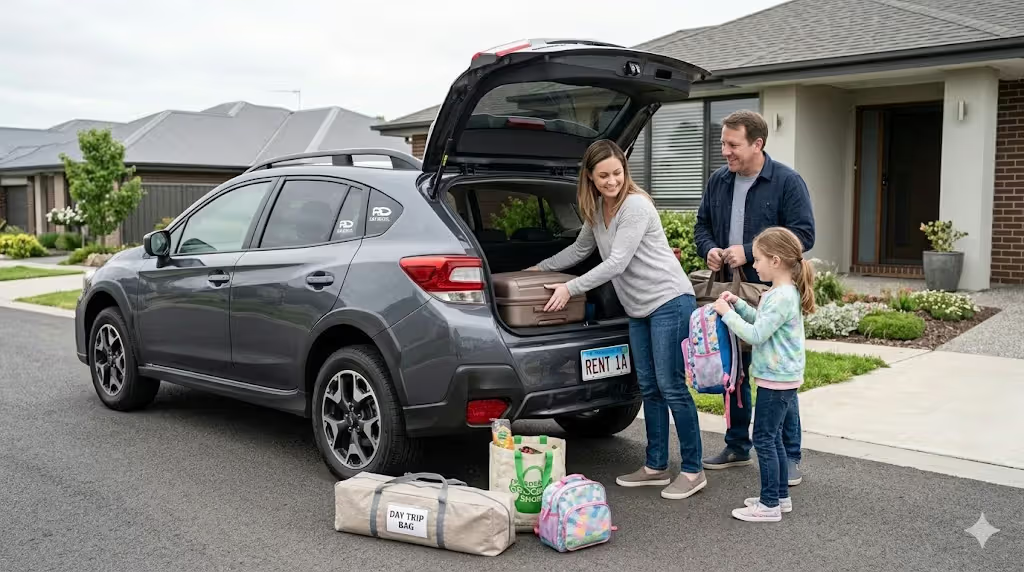
Pre-planned vacation meets unexpected collision: An uninsured motorist hits you two days before your planned road trip. Your vehicle requires 10-12 days of bodywork. Rental reimbursement lets you proceed with vacation plans rather than canceling everything and losing hotel deposits and prepaid activity fees. The coverage transforms a potential disaster into a manageable inconvenience—you're still taking that trip, just in a different car.
Author: Tara Livingston;
Source: trialstribulations.net
Common Mistakes When Adding Rental Reimbursement to Your Policy
Drivers consistently make preventable errors with this coverage.
Duplicate coverage purchases: Your premium credit card might include rental car benefits, but read that fine print carefully. Card coverage typically applies only to leisure or business rentals you initiate yourself, not accident-related rentals through insurance claims. That said, if you carry a commercial auto policy or specialty umbrella insurance, you might already have rental provisions. Audit all your coverage sources before buying rental reimbursement through your personal auto policy.
Insufficient limit selection: Choosing the absolute cheapest option—perhaps $25 daily—saves maybe $10 annually but leaves you financially exposed when area rental rates start at $45 per day. The annual premium difference between $30 daily and $50 daily often amounts to just $15-20. Saving that tiny amount backfires when you actually need the coverage and discover you're paying $20-30 daily out-of-pocket for weeks.
Overlooking policy exclusions: Mechanical failures don't trigger rental reimbursement. Your transmission grenades itself from normal wear and tear? Not covered. Some policies also deny coverage if you're at fault in an accident but don't carry collision insurance, or if the damage falls below your deductible threshold. Exclusions sections aren't fun reading, but they're crucial for understanding what you actually bought.
Never using purchased coverage: Some people pay for rental reimbursement annually for a decade, then file a claim and never think to activate it. They assume it happens automatically or forget they even have it. After any covered incident, explicitly ask your adjuster about rental reimbursement. Insurance companies won't proactively remind you about optional coverages you purchased—that's your responsibility.
Renting beyond your limits: You upgrade to a premium SUV at the rental counter because it's more comfortable for your bad back, even though your policy reimburses only standard sedan rates. Your insurer sends you a check based on economy pricing, leaving you to cover the $15-25 daily difference. Stick to vehicles comparable to yours unless you're prepared to pay upgrade costs yourself.
Lost documentation: You pay cash for the rental or toss receipts in the trash, then struggle to prove your expenses during reimbursement. Always maintain detailed records. Using direct billing? Get written confirmation from the rental agency that your insurance company received and paid the invoice correctly, or you might discover a collections notice months later.
Frequently Asked Questions About Rental Reimbursement Coverage
Rental reimbursement coverage won't prevent accidents or accelerate repair schedules, but it eliminates the immediate "how do I get around?" problem that follows every collision or comprehensive claim. For roughly the price of one fancy coffee per month, you avoid financial stress and logistical nightmares when your car's unexpectedly out of commission. Most drivers eventually use this coverage—nationwide repair times average almost two weeks, and few people can comfortably absorb $400-700 in surprise rental expenses.
Success comes down to choosing appropriate limits matching rental rates in your specific market and realistic repair times for your vehicle type. Match coverage to actual needs rather than automatically choosing the cheapest option available. Maintain organized documentation when filing claims, and don't hesitate asking your insurer detailed questions about the process.
Whether you're adding this coverage initially or reevaluating current limits, honestly assess your household's transportation vulnerabilities. If losing your primary vehicle for two weeks would genuinely create hardship—missed work, broken commitments, family chaos—rental reimbursement represents one of the most cost-effective protections available in the entire insurance marketplace.