
The right deductible can change your long-term insurance costs.
How to Choose the Best Deductible for Insurance Savings

Content
Selecting your insurance deductible feels like choosing between paying now or paying later. Most people pick a number that sounds reasonable without running the actual math. That's a mistake that can cost hundreds or thousands of dollars over the life of your policy.
Your deductible directly controls how much you pay in premiums every month and how much you'll owe if something goes wrong. The right choice depends on your specific financial situation, how often you file claims, and whether you can comfortably cover a larger out-of-pocket expense when needed. This guide walks through the calculation methods and decision factors that determine which deductible maximizes your long-term savings.
How Insurance Deductibles Actually Impact Your Premium Costs
Insurance companies price policies based on their expected payout risk. When you agree to cover more of the initial costs yourself, the insurer's risk drops—and so does your premium. This inverse relationship is consistent across auto, home, and health insurance, though the exact premium tradeoff varies by policy type and carrier.
For auto insurance, raising your deductible from $500 to $1,000 typically reduces your premium by 15-25% annually. Jumping to a $2,500 deductible might save you 30-40% compared to the $500 baseline. On a policy costing $1,500 per year with a $500 deductible, switching to $1,000 could drop your annual cost to $1,200—a $300 yearly savings. Move to $2,500, and you might pay just $975 annually, saving $525.
Homeowners insurance shows similar patterns but with larger dollar amounts. A policy that costs $2,000 annually with a $1,000 deductible might drop to $1,700 with a $2,500 deductible and $1,500 with a $5,000 deductible. The percentage savings often increase with home value—higher-value properties see more dramatic premium reductions when increasing deductibles.
These numbers aren't universal. Your actual premium difference depends on your location, claims history, credit score, coverage limits, and the specific insurer's pricing model. Some carriers offer aggressive discounts for higher deductibles; others barely budge. Request quotes at multiple deductible levels from at least three insurers before deciding. The carrier offering the best rate at $500 might not be the cheapest option at $2,500.
One critical detail: premium savings compound over time, but deductibles reset with each claim. If you save $300 annually by choosing a higher deductible, that benefit accumulates every year you don't file a claim. But each time you do file, you pay the full deductible amount regardless of how long you've been saving on premiums.
Calculate Your Break-Even Point: When Higher Deductibles Pay Off
The break-even calculation tells you how long you need to go without filing a claim before your premium savings offset the higher out-of-pocket risk. This mathematical framework is straightforward but requires accurate premium quotes for each deductible tier you're considering.
The basic formula: (Higher Deductible - Lower Deductible) ÷ Annual Premium Savings = Years to Break Even

Author: Tara Livingston;
Source: trialstribulations.net
If you're comparing a $500 deductible (premium: $1,500/year) against a $1,500 deductible (premium: $1,200/year), you're accepting $1,000 more risk to save $300 annually. Your break-even point is 3.33 years. If you go more than three years without a claim, you come out ahead. File a claim in year two, and you've lost money on that choice.
This gets more complex when you factor in multiple potential claims over a longer timeline. A better approach examines total cost scenarios across different claim frequencies.
Step-by-Step Savings Calculation Method
Start by gathering premium quotes for at least three deductible levels from your current or prospective insurer. Write down the exact annual cost for each option.
Calculate the premium difference between each tier. If your $500 deductible costs $1,500, your $1,000 deductible costs $1,200, and your $2,500 deductible costs $975, your annual savings are $300 (moving from $500 to $1,000) and $525 (moving from $500 to $2,500).
Next, project your total costs over a realistic timeframe—three to five years works well. Create scenarios for zero claims, one claim, and two claims during that period.
For the zero-claims scenario with a $500 deductible at $1,500/year, your three-year cost is $4,500. With a $1,000 deductible at $1,200/year, it's $3,600. You save $900 by choosing the higher deductible if nothing goes wrong.
For the one-claim scenario, add your deductible to the premium costs. With the $500 deductible: ($1,500 × 3) + $500 = $5,000. With the $1,000 deductible: ($1,200 × 3) + $1,000 = $4,600. You still save $400 even after filing once.
Run this calculation for two claims as well. The higher deductible advantage shrinks with each claim but often remains positive for several years.
Common Calculation Mistakes That Cost You Money
The biggest error is ignoring claim probability entirely. Some people choose high deductibles based purely on maximum premium savings without considering whether they're likely to file claims. If you've filed three auto claims in five years, you're not a good candidate for a $2,500 deductible regardless of the premium discount.
Another mistake: failing to account for premium increases after claims. When you file a claim with a low deductible, you pay less upfront but your premiums often rise substantially at renewal. That rate increase can persist for three to five years. Filing a $2,000 claim with a $500 deductible might save you $1,500 immediately but cost you an extra $400 per year in higher premiums—negating your savings within four years.
People also forget that deductibles apply per claim, not per year. If you have two separate incidents in one year, you pay your deductible twice. That $1,000 deductible becomes $2,000 in total out-of-pocket costs.
Finally, don't compare premiums from different carriers without verifying coverage equivalence. A lower premium with a higher deductible from Company A means nothing if their coverage limits are $100,000 less than Company B's policy. Match coverage details before running cost comparisons.
Match Your Deductible to Your Risk Tolerance and Financial Cushion
Premium savings calculations matter, but they're not the only consideration. Your deductible choice must align with your ability to cover unexpected expenses without financial hardship.
Financial advisors generally recommend having three to six months of living expenses in emergency savings before considering deductibles above $1,000. If you're living paycheck to paycheck, a $2,500 deductible creates real risk. An accident or covered loss forces you to choose between paying the deductible or going without necessary repairs or medical care.
The deductible you choose should never exceed what you could comfortably pay from savings within 30 days without disrupting your other financial obligations. I've seen clients choose high deductibles for the premium savings, then face serious financial stress when they actually need to file a claim. Your insurance should reduce stress, not create it.
— Marcus Chen, CFP®, a financial planner with Westbridge Financial Partners.
Income stability plays a role too. Someone with a steady salary, strong job security, and substantial savings can handle higher deductibles with less concern. Freelancers, commission-based workers, or anyone with irregular income should lean toward lower deductibles to avoid compounding financial stress during already-difficult periods.
Psychological comfort matters more than many people admit. Some individuals lose sleep over the possibility of a large unexpected expense, even if they have the savings to cover it. If a $2,500 deductible creates ongoing anxiety, the $400 annual premium savings isn't worth the mental cost. Choose the deductible level that lets you stop thinking about it.
Your broader financial picture also influences this decision. If you're aggressively paying down high-interest debt, keeping a lower deductible preserves your debt-payoff momentum. If you're building wealth and can absorb occasional larger expenses, higher deductibles free up money for investments that generate returns exceeding your premium savings.
Age and health status matter for health insurance deductibles specifically. Younger, healthier individuals with minimal expected healthcare use benefit more from high-deductible health plans paired with HSAs. Older adults or those managing chronic conditions typically save money with lower deductibles despite higher premiums.

Author: Tara Livingston;
Source: trialstribulations.net
Your Claims History Should Drive Your Deductible Decision
Past claim frequency is the single best predictor of future insurance costs. If you've filed multiple claims in recent years, you'll likely file more. If you've gone a decade without a claim, you'll probably continue that pattern.
Pull your claims record for the past five years across all insurance types. Zero claims? You're an excellent candidate for higher deductibles. The premium savings will almost certainly exceed your total costs over any reasonable timeframe. One claim in five years? Higher deductibles still make sense for most people. Two or more claims? Lower deductibles deserve serious consideration.
This analysis requires honesty about the causes of past claims. If your two auto claims resulted from parking lot incidents in areas you no longer frequent, they're less predictive than two at-fault accidents on your regular commute. If your homeowners claim was for hail damage in a region where you no longer live, it shouldn't weigh heavily on your current decision.
Consider your lifestyle changes too. Adding a teenage driver to your auto policy dramatically increases claim probability—that's not the time to maximize your deductible. Buying a home in a flood zone or wildfire area increases homeowners claim likelihood. Adjust your deductible strategy when your risk profile shifts.
Some people intentionally avoid filing claims for minor damage to preserve their claims-free status and lower premiums. This strategy works well with higher deductibles. If your deductible is $2,500 and you have $2,000 in damage, you're paying out of pocket either way. With a $500 deductible, you might file that claim for $1,500 in coverage, triggering premium increases that cost you more long-term.
The filing frequency sweet spot for most people is once every 7-10 years for auto insurance and once every 10-15 years for homeowners insurance. If you're beating these averages, lean toward higher deductibles. If you're filing more often, the math favors lower deductibles despite higher premiums.

Author: Tara Livingston;
Source: trialstribulations.net
Side-by-Side Comparison: $500 vs. $1,000 vs. $2,500 Deductibles
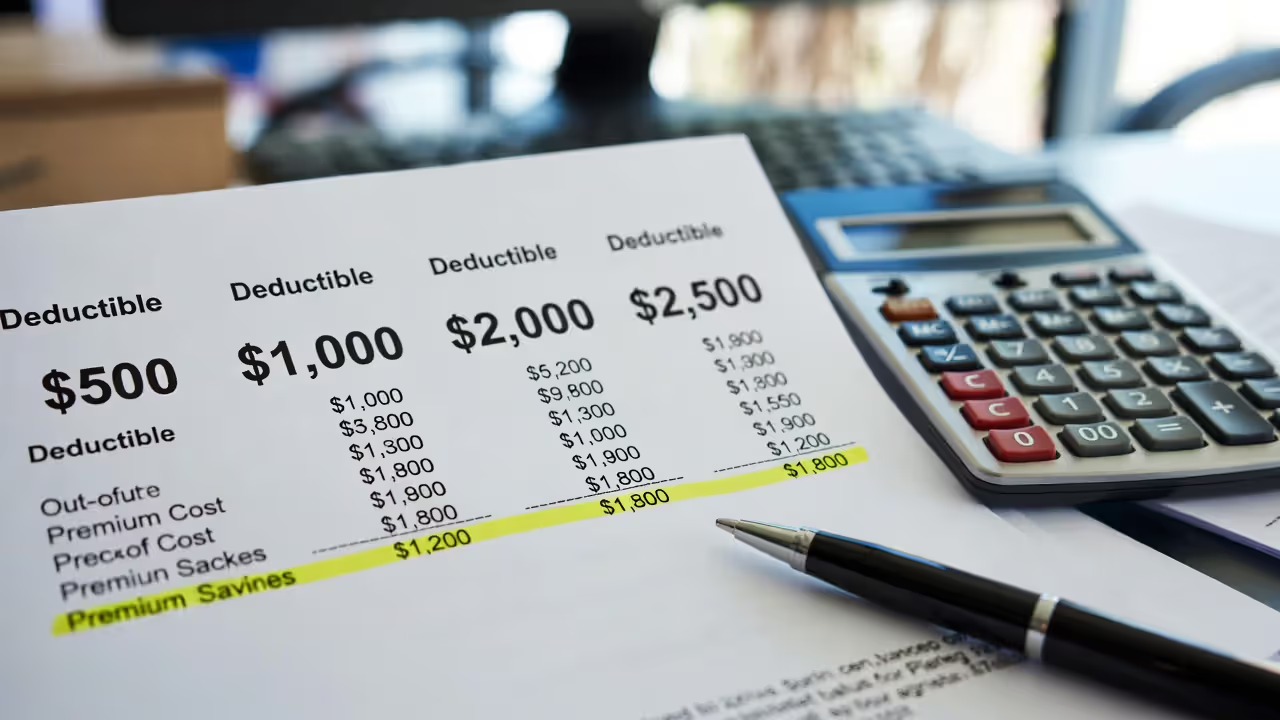
Real numbers make the abstract concrete. This comparison uses typical auto insurance premiums for a mid-range policy, though your actual costs will vary based on coverage levels, location, and personal factors.
| Deductible Amount | Average Annual Premium | Annual Savings vs. $500 | Years to Break Even (No Claims) | Total 3-Year Cost (0 Claims) | Total 3-Year Cost (1 Claim) | Total 3-Year Cost (2 Claims) | Best For |
| $500 | $1,500 | — | — | $4,500 | $5,000 | $5,500 | Frequent claimers; limited emergency savings; low risk tolerance |
| $1,000 | $1,200 | $300 | 1.7 years | $3,600 | $4,600 | $5,600 | Moderate emergency fund; average claim frequency; balanced approach |
| $2,500 | $975 | $525 | 2.9 years | $2,925 | $5,425 | $7,925 | Strong emergency fund; rare claims; maximum savings priority |
The zero-claims scenario shows the maximum savings potential. Over three years, the $2,500 deductible saves you $1,575 compared to the $500 option—a 35% reduction in total insurance costs.
With one claim, the $1,000 deductible becomes the most economical choice. You save $400 versus the $500 deductible and $825 versus the $2,500 option. This middle ground provides meaningful premium savings while limiting out-of-pocket exposure.
Two claims in three years flip the equation entirely. The $500 deductible costs $5,500 total, while the $2,500 deductible costs $7,925—a $2,425 penalty for choosing higher risk coverage. The $1,000 deductible splits the difference at $5,600, just $100 more than the low-deductible option.
These numbers demonstrate why claim frequency matters so much. If you average more than one claim every three years, lower deductibles typically win. File claims less often than once every four years, and higher deductibles generate substantial savings.
Remember that these calculations don't account for premium increases after claims. Filing two claims with a $500 deductible might raise your premiums by $400-600 annually for the next three years, adding $1,200-1,800 to your long-term costs. This hidden expense often makes higher deductibles more economical even for moderate claimers.
Author: Tara Livingston;
Source: trialstribulations.net
Decision Framework: 5 Questions to Find Your Optimal Deductible
Stop guessing. Answer these five questions to identify the best deductible for savings based on your specific situation.
Question 1: Can you comfortably pay your highest potential deductible from savings within one week? If no, that deductible is too high regardless of premium savings. If yes, you have the financial foundation for higher deductibles.
Question 2: How many insurance claims have you filed in the past five years across all policies? Zero to one claim: choose higher deductibles. Two claims: consider mid-range deductibles. Three or more claims: stick with lower deductibles.
Question 3: What's your annual premium savings for each deductible increase? Calculate the exact dollar amount. If moving from $500 to $1,000 saves you $250 annually, you'll break even after two claims-free years. If it only saves $100, you need five years to break even—probably not worth the risk.
Question 4: Has your risk profile changed recently? New teen driver, moved to a high-risk area, bought an expensive home, or developed health conditions? These changes increase claim probability and favor lower deductibles. Moved to a safer neighborhood, kids moved out, or improved your health? Consider raising deductibles.
Question 5: How much mental space does insurance anxiety occupy? Be honest. If you'll worry constantly about covering a high deductible, the premium savings aren't worth your peace of mind. If you never think about insurance except when paying the bill, maximize your deductible to minimize that bill.
Your answers create a clear decision framework. Strong financial position + low claim history + meaningful premium savings + increased risk tolerance = choose the highest deductible available. Weak financial cushion + frequent claims + minimal premium savings + high anxiety = stick with lower deductibles.
Most people fall somewhere in the middle. The $1,000 deductible often represents the optimal balance—meaningful premium savings without excessive out-of-pocket risk. It's high enough to discourage filing minor claims but low enough to avoid financial hardship when serious losses occur.
Review your deductible choice annually. As your financial situation improves, your emergency fund grows, or your claims history changes, adjust accordingly. The best deductible for savings isn't static—it evolves with your circumstances.
Frequently Asked Questions About Choosing Insurance Deductibles
Making Your Deductible Decision Work Long-Term
Your deductible choice represents a calculated bet on your future claim frequency balanced against your current financial capacity. Get it right, and you'll save hundreds or thousands of dollars over the years. Get it wrong, and you'll either overpay in premiums or face financial stress when filing claims.
The best deductible for savings isn't the highest deductible available—it's the highest deductible you can comfortably afford based on your emergency savings, claim history, and risk tolerance. For most people, that sweet spot falls between $1,000 and $2,500 for auto and homeowners insurance, where premium savings become meaningful without creating unmanageable financial exposure.
Run the actual numbers for your situation. Request quotes at three deductible levels, calculate your break-even points, project costs across different claim scenarios, and honestly assess your financial cushion. This 30-minute exercise can identify savings opportunities that compound for decades.
Remember that your optimal deductible changes as your life circumstances evolve. Review your choice annually, especially after major life changes like job transitions, home purchases, adding drivers, or building substantial savings. The deductible that made sense five years ago might be costing you money today.
Finally, pair your deductible strategy with smart claims management. Don't file claims for amounts barely exceeding your deductible—the premium increases often cost more than the payout. Build your emergency fund specifically to cover your deductible amount so you're never forced to file claims for minor losses. These habits maximize the value of higher deductibles while protecting you from financial hardship when serious losses occur.