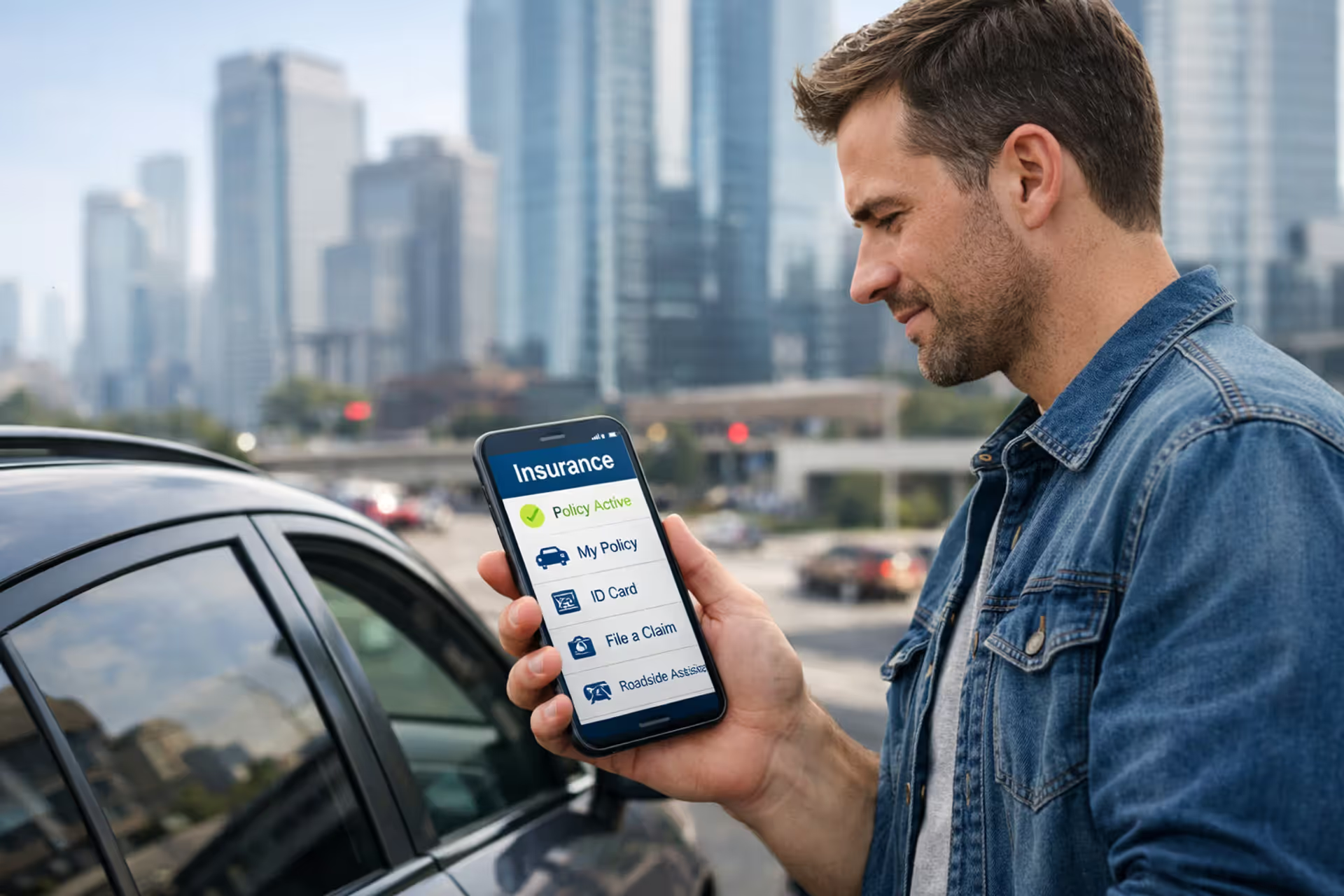
driver using insurance app inside car
Root Insurance Review Is App-Based Coverage Worth It

Content
Back in 2016, I kept seeing these Root Insurance commercials. The concept seemed almost ridiculous—they'd judge my insurance rate based on how well I actually drive instead of lumping me in with every other 28-year-old guy in my neighborhood. Just download their app, let it watch you drive for a while, and boom—personalized pricing.
Naturally, I assumed it was marketing hype. Insurance companies always promise savings, right?
But Root actually operates under a fundamentally different model. Their app monitors everything: how aggressively you brake, whether you're texting at red lights, what time you're out driving. Then they base your entire premium on that performance data. Drive like your grandmother? You'll probably pay less. Drive like you're auditioning for Fast & Furious? They might refuse to insure you altogether.
After digging into how Root really works—the good, the frustrating, and the legitimately surprising parts—here's what you need to know before spending two weeks with their app tracking your every move.
What Makes Root Different from Traditional Auto Insurers
Traditional insurance companies operate on educated guesses. You're 22 years old? Statistically risky. You live in downtown Detroit? Higher premiums. You dropped out of college? That'll cost you extra. An agent plugs your information into their system, and out pops a rate based on what millions of people who vaguely resemble you have cost the company over decades.
Root threw that playbook in the garbage. They don't maintain local offices. No agents exist to shake your hand and discuss policy options. They won't even give you a quote until you've proven yourself behind the wheel.
Their entire operation runs through smartphone technology. Download their app, drive around while it monitors your behavior, and after collecting sufficient data, their system calculates what you'll pay. Two people driving identical Toyota Camrys in the same apartment complex might see wildly different quotes—one could pay $120 monthly while their neighbor pays $285, purely based on driving habits.
You handle everything through that app. Updating coverage limits, filing accident claims, downloading proof-of-insurance cards—it's all digital. Root eliminated the traditional infrastructure, which theoretically translates to lower overhead costs and better rates for customers.
Author: Calvin Prescott;
Source: trialstribulations.net
How the Root Test Drive Works
Start by downloading Root's mobile app. They'll ask standard questions: driver's license details, your car's information, current address. Then you enter the evaluation phase.
Keep the app installed with location permissions enabled. Root automatically recognizes when your car starts moving and begins analyzing your performance. Nothing requires manual activation—the system handles trip detection on its own.
Their algorithm scrutinizes multiple factors:
- Braking patterns: Gentle, gradual stops score well. Slamming brakes constantly suggests you follow too close or aren't paying attention
- Driving schedule: Late-night trips (particularly midnight through 4 a.m.) devastate your score, since accident rates skyrocket during those hours
- Phone interaction: Touch your phone while moving, even briefly? That single action can crater an otherwise perfect trip score
- Total miles driven: Lower annual mileage means fewer accident opportunities—10,000 miles per year beats 30,000
- Speeding behavior: Consistently driving 15 over the limit damages your rating, though they claim to account for traffic flow patterns
Root requires about 300-500 miles worth of trip data before generating your quote. Daily commuters typically finish within 14-21 days. Weekend-only drivers might spend five or six weeks in evaluation mode.
Your current score displays inside the app throughout this period. Watch it fluctuate as exceptional drives (smooth highway cruise) and terrible ones (three hard brakes in parking lot chaos) get averaged together. Once you've logged sufficient miles, Root issues a binding quote that remains valid for 30 days.
Here's the crucial part: completing the test drive creates zero obligation. Don't like the quote they offer? Just uninstall the app and forget about it. However, once you've purchased actual coverage, cancellation requires formal notification—you can't simply delete the app. Standard cancellation procedures apply, potentially including pro-rated fees depending on timing.

Author: Calvin Prescott;
Source: trialstribulations.net
Who Root Accepts (and Rejects)
Root enforces significantly tougher eligibility standards compared to mainstream carriers. They automatically disqualify drivers with:
- DUI or reckless driving convictions within five years
- License suspensions during the past three years
- Multiple at-fault accidents (more than two within three years)
- Exotic or racing-modified vehicles
Anyone under 18 can't get coverage. Drivers requiring SR-22 certificates (court-mandated insurance for serious violations) won't qualify either. Root currently operates in just 30 states—California, New York, and Massachusetts residents can't access their service at all.
Meeting baseline eligibility doesn't guarantee coverage. A disastrous test drive performance might prompt Root to decline offering you a policy entirely. Or they'll quote rates so astronomical that Geico suddenly looks affordable. They're perfectly comfortable turning away risky drivers.
Root Insurance Pricing: How Much Can You Actually Save?
Marketing materials love touting that "Root customers save an average of $900 annually." That statistic includes people switching from expensive high-risk insurers after accidents. Your realistic savings potential depends heavily on current rates and actual driving habits.
Here's what rate comparisons look like across different driver categories:
| Driver Profile | Root Typical Range | Traditional Insurer Range | Estimated Annual Savings |
| Clean record, ages 35-50, under 8,000 annual miles | $1,200 - $1,600 | $1,400 - $1,800 | $200 - $400 |
| Average driver, ages 30-45, one speeding ticket, 12,000 annual miles | $1,800 - $2,400 | $2,000 - $2,600 | $200 - $300 |
| Under 25, spotless record, excellent test drive performance | $2,400 - $3,200 | $3,500 - $5,000 | $1,100 - $1,800 |
These represent full coverage policies with $500 deductibles. Your actual premium depends on state regulations, vehicle value, and specific coverage choices.
See the pattern emerging? Younger drivers with legitimately safe habits capture the biggest savings because Root's system overrides the automatic "young person penalty" that traditional companies apply. A careful 23-year-old driver doesn't statistically pose higher risk than a 40-year-old who drives aggressively—but conventional insurers charge them like they do.
Middle-aged drivers already enjoying multiple discounts from Allstate or Progressive might see marginal savings. Root can't magically undercut everyone for every driver profile. Their telematics approach benefits safe drivers currently overpaying due to age, location, or other demographic factors beyond their control.
Here's something most reviews gloss over: Root recalculates your rate every renewal (typically six months) based on ongoing monitoring. Your driving patterns during month seven directly affect your next premium. Start checking your phone more frequently during drives? Your rate could jump 18-22% at renewal. Traditional carriers might implement 5% annual increases regardless of behavior changes.
This cuts both directions. Maintain excellent habits and your premium can actually decrease at renewal. But the unpredictability makes budgeting trickier compared to traditional carriers offering stable rates.
One more quirk worth noting: Root doesn't stack multiple discounts like conventional insurers. No good student discount available. Defensive driving course completion? Doesn't matter. Bundling with homeowners insurance? They don't offer it. Their reasoning? Your driving score already captures your true risk level, rendering additional discount categories redundant.

Author: Calvin Prescott;
Source: trialstribulations.net
Mobile App Features and User Experience
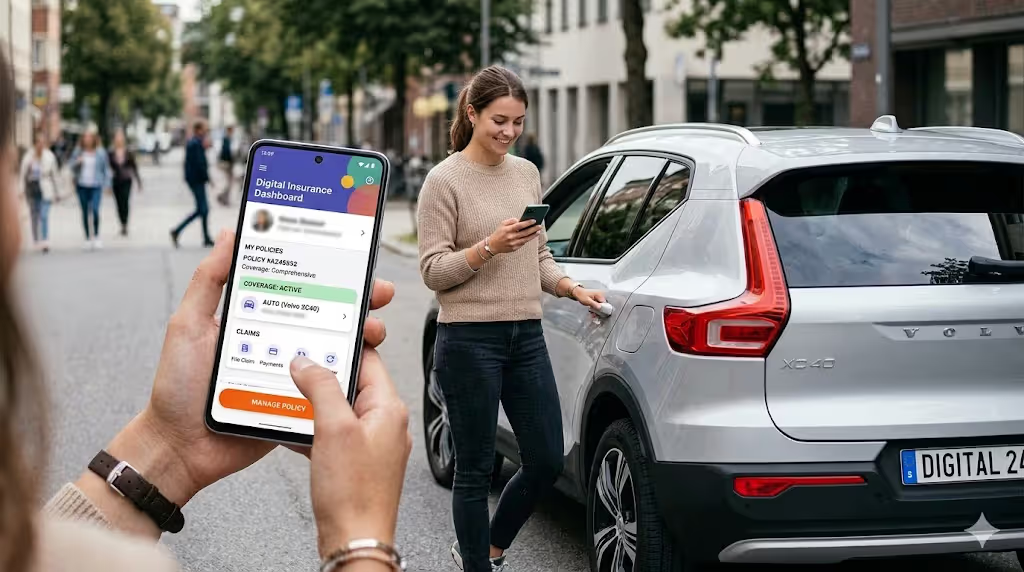
Root's app isn't just where you make payments—it's literally your only connection to the entire company. Every interaction happens through this single interface.
The home screen displays your current driving score (for active policyholders being monitored), coverage status, and next payment deadline. Tap into coverage details and you'll find liability limits, deductibles, and optional coverages explained without confusing insurance industry jargon. Actual policy documents exist if you need them, but most information stays accessible in plain language.
During test drive evaluation, the app becomes surprisingly addictive. Each individual trip receives its own score. Morning commute scores 91/100? Evening drive home drops to 84/100 because you braked hard twice? This granular trip-by-trip feedback helps you understand exactly what behaviors Root values.
The test drive turned into this weird game for me. I'd leave bigger gaps between my car and the one ahead just to avoid sudden braking. By the second week, I was genuinely changing my driving—leaving home ten minutes earlier for appointments so I wouldn't feel rushed. My final quote came back at $140 less monthly compared to what Progressive charged me.
— As Sarah M.
Policy management works smoothly for routine tasks. Adding a vehicle takes maybe four taps. Want higher liability limits? Adjust digital sliders and watch your new premium calculate instantly. Digital insurance cards live in the app and satisfy legal requirements during traffic stops in most states.
The weakness? Complex questions or unusual situations leave you stranded. Root doesn't provide phone support for policy inquiries whatsoever. Your only options are in-app chat (response times vary from minutes to days) or email communication. Customers accustomed to calling their agent for advice find this limitation genuinely frustrating.
Battery drain during test drive evaluation annoys plenty of users. The app runs continuously in your phone's background to detect trips automatically, which can reduce battery life by 12-20% depending on device model. After becoming a policyholder, monitoring continues but battery impact typically lessens since Root doesn't need to obsessively track every single trip as intensively.
Available Coverage Options and Discount Opportunities
Root offers standard coverage types available from any legitimate insurer, though they skip certain specialty options that traditional companies provide.
| Coverage Type | What It Protects | Annual Cost Addition |
| Liability | Injuries and property damage you're responsible for after causing an accident | Built into base premium |
| Collision | Repairs to your vehicle after crashes, even when you caused them | +$300 - $800 |
| Comprehensive | Theft, vandalism, weather damage, animal collisions | +$200 - $500 |
| Rental Reimbursement | Rental car expenses while your vehicle undergoes repairs | +$20 - $40 |
| Roadside Assistance | Towing, battery jumps, tire changes, lockout services | +$15 - $30 |
Pricing varies based on vehicle value, selected deductible amounts, and state-specific requirements.
Liability coverage follows industry-standard formats—you'll choose limits like 100/300/100 (covering $100,000 per injured person, $300,000 total per accident, and $100,000 for property damage). Root automatically includes uninsured motorist protection where state laws require it.
Collision and comprehensive coverages come with deductible options ranging from $250 up to $2,000. Higher deductibles reduce monthly premiums but increase out-of-pocket costs after accidents. Most people find $500 deductibles strike a reasonable balance.
Root's discount opportunities are surprisingly sparse:
- Referral program: Collect $25 when friends finish a test drive, $100 if they purchase coverage
- Multi-vehicle discount: Bundle multiple cars under one policy for roughly 5-10% savings
- Pay-in-full discount: Pay your complete six-month premium upfront and save approximately 5%
Notice what's conspicuously absent? No military discounts. No alumni association savings. No good student programs. No bundling with homeowners or renters insurance. Root maintains that your driving score already reflects genuine risk, making traditional discount categories unnecessary.
Whether you buy this philosophy depends largely on how many discounts you currently receive elsewhere.
Filing Claims with Root: Process and Customer Ratings
Claims happen exclusively through the app. No 1-800 number exists for reporting accidents.
Tap the "File a Claim" button, select what happened (collision, theft, vandalism, glass damage), then answer guided questions about the incident. For crashes, the app walks you through photographing vehicle damage from multiple angles, capturing accident scene details, documenting other drivers' insurance information, and uploading any police report details.
Root assigns an adjuster within 24 hours for most claims. The app shows real-time status updates as processing advances: adjuster assigned, vehicle inspection scheduled, repair estimate approved, payment issued. Straightforward rear-end collisions with clear liability often settle within 5-7 business days.
Comprehensive claims (like hail damage or stolen catalytic converters) typically process faster since fault isn't disputed. Glass claims for windshield chips sometimes get resolved same-day through Root's partner repair networks, with direct billing so you only pay your deductible amount.
Now for the messier reality. Root's complaint ratio with the National Association of Insurance Commissioners runs above industry median—meaning they receive more complaints per policy than the typical insurer. Common grievances include:
- Adjusters disappearing for days after initial assignment
- Disputes over vehicle valuations (Root's estimates coming in lower than customers expect)
- Difficulty escalating disagreements to supervisors
- Confusion surrounding coverage denials
That said, plenty of customers report hassle-free experiences with minor claims. The app-based process eliminates phone tag completely, and Root's digital payment system deposits settlements via direct transfer instead of mailing paper checks that take forever.
Major limitation worth emphasizing: Root offers no accident forgiveness programs whatsoever. Your first at-fault crash will spike your premium at next renewal, possibly 20-30%. Your driving score drops too since the app continues monitoring post-accident behaviors. Traditional insurers often forgive one accident for long-term customers with otherwise clean records, keeping rates unchanged. Root's system treats every accident as a data point affecting future pricing, with zero forgiveness provisions.

Author: Calvin Prescott;
Source: trialstribulations.net
Root Insurance Ratings: Financial Strength and Customer Satisfaction
Root carries a "B" (Fair) financial strength rating from AM Best, the insurance industry's primary stability evaluator. This sits two full notches below the "A" (Excellent) ratings that State Farm or Geico maintain.
Translation: Root maintains adequate reserves for paying claims under normal conditions, but faces challenges that century-old established insurers don't. Root launched in 2015 and went public in 2020—they're essentially a teenager compared to carriers founded before World War II. That "B" rating shouldn't trigger immediate panic, but it reflects Root's status as a newer player still proving long-term viability.
J.D. Power hasn't included Root in their annual auto insurance satisfaction rankings yet due to insufficient market share. However, Root maintains respectable ratings on app stores: 4.6 out of 5 stars on Apple's App Store (from 180,000+ reviews) and 4.2 out of 5 on Google Play (from 90,000+ reviews). These ratings primarily reflect user experience with app functionality rather than overall satisfaction or claims handling quality.
The Better Business Bureau assigned Root an "A+" accreditation rating despite receiving over 1,200 customer complaints during the past three years. Common complaint patterns:
- Disputes over test drive scores and resulting premium quotes
- Frustration with claims handling speed or settlement offers
- Difficulty canceling coverage or obtaining refunds
- Unexpectedly large rate increases at six-month renewals
Root responds to most BBB complaints, though customers don't universally feel satisfied with resolutions offered. The complaint volume seems substantial until you consider Root's rapidly expanding customer base—established insurers receive far more complaints in absolute numbers simply due to insuring millions more policies.
Root sells coverage in 30 states currently: Alabama, Arizona, Arkansas, Colorado, Connecticut, Delaware, Georgia, Illinois, Indiana, Iowa, Kansas, Kentucky, Louisiana, Maryland, Michigan, Mississippi, Missouri, Montana, Nebraska, Nevada, New Mexico, North Dakota, Ohio, Oklahoma, Pennsylvania, South Carolina, Tennessee, Texas, Utah, Virginia, West Virginia, and Wisconsin.
Major markets they can't access include California (which restricts telematics data usage), New York (challenging regulatory environment), Florida (difficult insurance market overall), and Massachusetts (requires specific policy structures Root doesn't offer).
Pros and Cons: Should You Switch to Root?
Root's telematics approach creates definitive winners and losers. Understanding which category describes you determines whether investing time in their test drive makes sense.
Root delivers excellent value for:
- Younger drivers (under 25) with legitimately safe habits who currently pay outrageous rates purely based on age
- People driving shorter distances during normal daytime hours who rarely drive between midnight and 4 a.m.
- Anyone comfortable managing their entire insurance relationship exclusively through a smartphone app
- Drivers willing to modify specific behaviors (stopping phone usage, braking more gradually) to improve scores
- Those currently overpaying due to ZIP code-based pricing or credit score factors that Root minimizes
Root disappoints for:
- Drivers requiring SR-22 certificates or those with recent DUIs
- Shift workers who regularly drive between midnight and 4 a.m. (this absolutely destroys your score)
- People wanting to bundle auto and homeowners insurance for multi-policy discounts
- Those preferring to call an agent for discussing coverage questions
- Residents of excluded states like California, New York, or Florida
- Anyone uncomfortable with continuous GPS tracking and behavior monitoring
The test drive offers a risk-free method for discovering whether Root saves you money. You'll spend two to three weeks carrying your phone during drives, but purchasing coverage remains entirely optional. If Root quotes $145 monthly while Geico charges $215, the app-based trade-offs might justify switching. If Root comes in at $208 versus Geico's $215, that minimal $7 monthly savings probably doesn't warrant the hassle.
Consider volatility factors: Root's rates can swing dramatically at renewal based on your continued driving performance. Traditional insurers might implement 5-10% annual increases. Root could impose a 28% increase if your habits deteriorate—or a 17% decrease if you maintain excellent performance. This variability demands ongoing attention to your score if maintaining low rates matters to you.
Frequently Asked Questions About Root Insurance
Root Insurance genuinely operates differently from traditional auto insurance—it's not just Geico wearing fancier tech clothing. The telematics pricing model rewards legitimately safe driving habits while penalizing risky behaviors, completely regardless of whether you're 23 or 53 years old.
For young drivers with clean records, commuters driving predictable routes during daylight hours, or anyone currently overpaying due to ZIP code or demographic factors, Root's test drive merits two weeks of your time. Worst possible outcome? You spend 14 days with an app running in your phone's background, then decline a quote failing to beat your current rate.
The app-only approach isn't universally appealing. If you value agent relationships, need guidance on complex coverage decisions, or prefer rate stability over score-based volatility, Root's model probably won't satisfy you. And that "B" financial strength rating, while adequate, doesn't match the century-old stability offered by top-tier insurers.
Root's fundamental premise—judging drivers by actual behavior rather than demographic assumptions—makes logical sense. Whether it makes practical sense for your specific situation depends on your driving habits, comfort with technology, and willingness to accept continuous monitoring in exchange for potentially substantial savings.