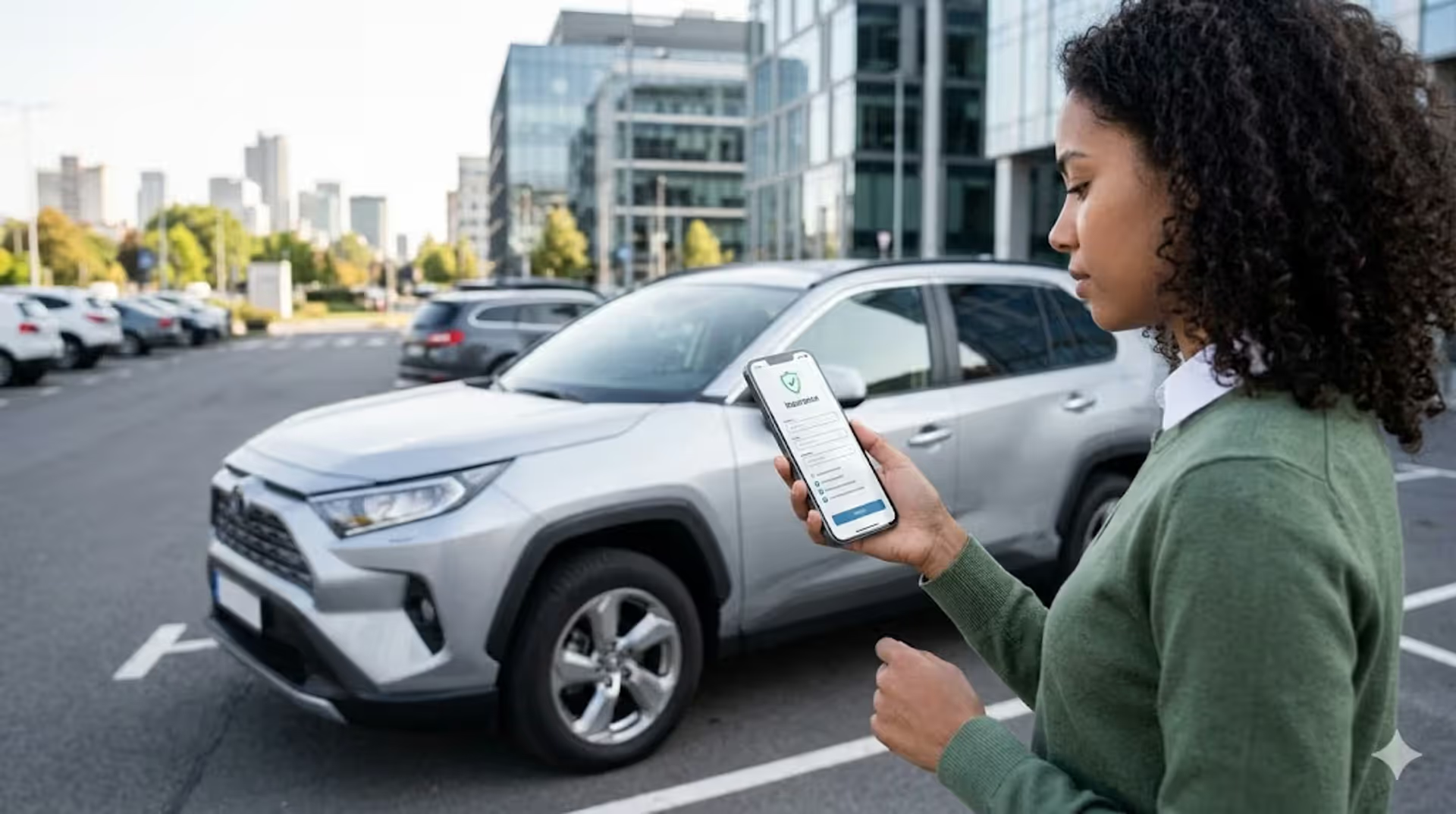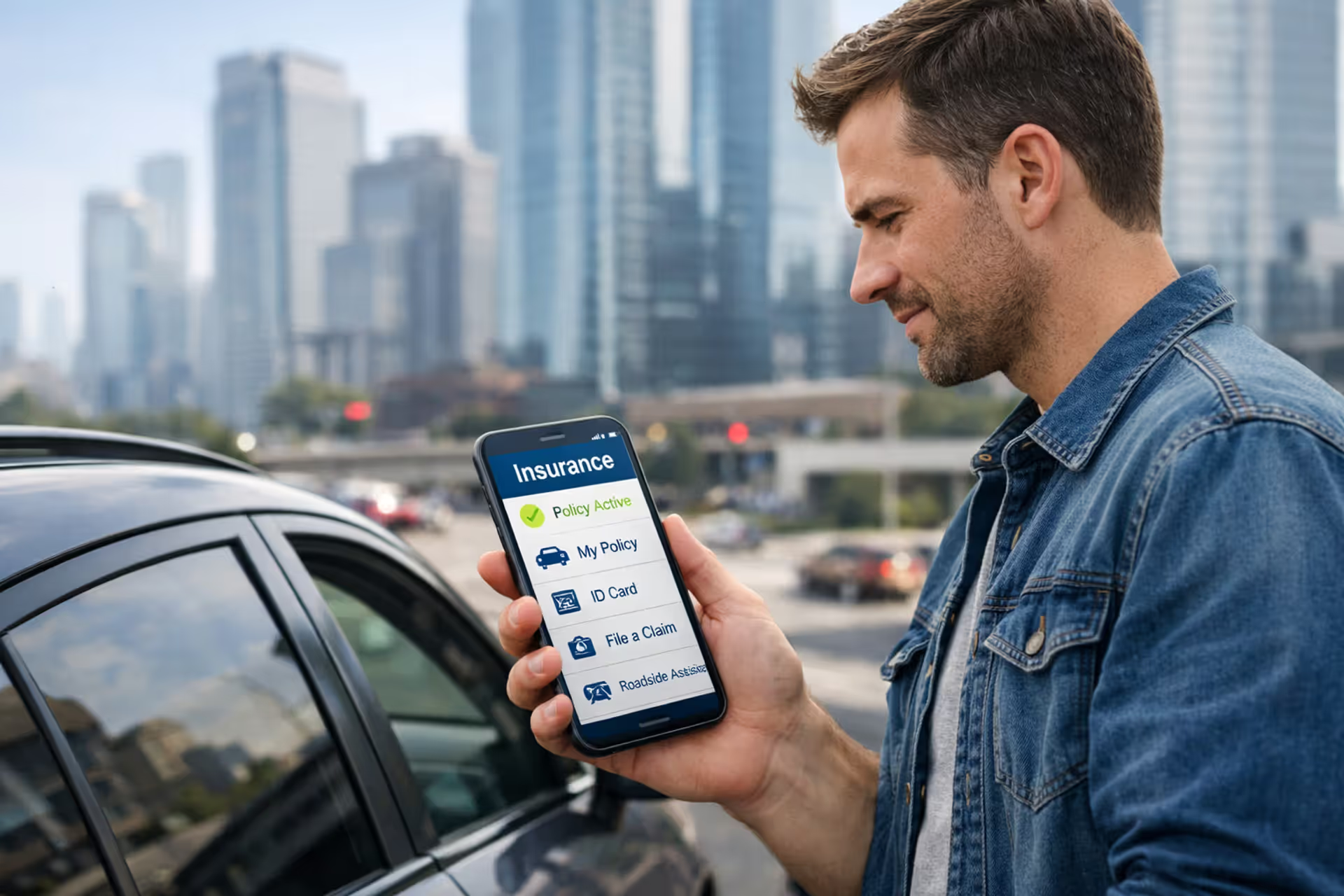
driver using mobile app to manage car insurance
Progressive Insurance Review Is It Worth the Price

Content
Progressive has been selling car insurance since 1937, but the company you see advertising on every streaming platform today bears little resemblance to that Cleveland-based startup. With roughly 13% of the U.S. auto insurance market and $50 billion in annual premiums, Progressive now sits as the third-largest car insurer in America—behind State Farm and Geico, but ahead of household names like Allstate and USAA.
The company built its reputation on two pillars: aggressive pricing for non-standard drivers (those with accidents, tickets, or gaps in coverage) and technological innovation. Progressive was the first major carrier to let customers compare rates from competitors on its own website, and it pioneered usage-based insurance through its Snapshot program. But being first doesn't always mean being best, and Progressive's rapid growth has come with trade-offs that affect everything from customer service wait times to claims settlement practices.
This review examines whether Progressive delivers value for your specific situation, not just in theory but based on pricing data, customer experience metrics, and the fine print most people skip.
What Makes Progressive Different From Other Auto Insurers
Progressive carved out its niche by insuring drivers that other companies wouldn't touch—or would only cover at astronomical rates. If you have a DUI, multiple speeding tickets, or a lapsed policy, Progressive often quotes lower premiums than competitors. The company uses sophisticated risk modeling that looks beyond simple red flags, which means a 22-year-old with one accident might get a better deal here than at a carrier that relies on broader age-based pricing.
The Name Your Price tool, launched in 2008, flipped the traditional insurance shopping experience. Instead of getting a quote and deciding whether to accept it, you tell Progressive your budget and the system adjusts coverage limits to hit that number. This works well if you understand insurance terminology, but it can lead to dangerously low liability limits for buyers who just want the cheapest legal minimum.
Progressive excels at three customer segments: drivers with imperfect records, tech-savvy customers who want mobile-first service, and people who bundle multiple vehicles or policies. The company's app consistently ranks among the best in the industry, with features like roadside assistance dispatch, digital ID cards, and claims photo submission that actually work smoothly.
Where Progressive falls short: white-glove customer service. The company operates primarily through direct sales and independent agents, which means you're unlikely to develop a relationship with a dedicated agent who knows your situation. If you value sitting down with someone who remembers your name and policy details, a captive agent model (State Farm, Allstate) might suit you better.
Author: Brandon Whitaker;
Source: trialstribulations.net
Progressive works best for cost-conscious drivers comfortable managing their policy digitally, especially those with blemished driving records. It's less ideal for customers who want personalized service or those with pristine records who might find better rates at companies that reward longevity and perfect driving histories more generously.
How Progressive's Snapshot Program Affects Your Premium
Snapshot represents Progressive's biggest bet on the future of auto insurance: the idea that how you drive matters more than demographic categories. Instead of charging all 20-year-olds high rates because statistics show they crash more often, Snapshot tracks individual behavior and adjusts your premium accordingly.
How Snapshot Tracking Works
You have two options for Snapshot participation. The mobile app version uses your phone's sensors to monitor trips, while the plug-in device connects to your car's diagnostic port. Both track the same core behaviors: hard braking events, time of day you drive, mileage, and speeding (app version only). The monitoring period typically lasts six months, after which Progressive calculates your discount or surcharge.
The system flags a "hard brake" when you decelerate faster than 7 mph per second—roughly what happens when you slam the brakes to avoid rear-ending someone. Late-night driving (midnight to 4 a.m.) counts against you because crash rates spike during these hours. If you use the mobile version, driving more than 80 mph triggers a speeding event.
Here's what surprises most users: Snapshot starts with a participation discount (usually 10-15%) just for signing up, then adjusts from there. You can't end up paying more than you would without Snapshot, but you can lose that initial discount if your driving habits look risky. The final adjustment can range from a 5% surcharge (losing most of your participation bonus) to a 30% discount.
Privacy concerns are legitimate. Progressive collects second-by-second location data, speed, and phone usage patterns (the app detects if you're handling your phone while moving). The company states it doesn't sell this data to third parties and won't use it to deny claims, but it does use aggregate data to refine pricing models. If you're involved in an accident, Progressive can theoretically access your Snapshot data, though the company maintains it doesn't use telematics to determine fault.
Average Savings and Real User Results
Progressive claims the average Snapshot user saves $146 annually, but this figure masks enormous variation. Analysis of customer reports suggests three distinct outcome groups:
Low-mileage suburban drivers with predictable schedules often see the full 25-30% discount. If you drive 8,000 miles yearly, mostly between 9 a.m. and 5 p.m., with minimal hard braking, you'll likely maximize savings.
Average commuters typically land in the 10-18% discount range. You'll trigger occasional hard braking events (city driving makes this nearly inevitable), and if your commute includes any late-night shifts or early morning drives, you'll lose some points there.
Urban drivers, gig workers, and night-shift employees frequently see minimal savings or small surcharges. City driving generates constant hard braking events—not because you're driving recklessly, but because traffic patterns require sudden stops. Delivery drivers and bartenders who work late hours face automatic penalties for driving during high-risk periods, even if they're stone-cold sober and cautious.
One often-overlooked factor: Snapshot measures phone handling while driving, and this kills many people's discounts. If you touch your phone for GPS adjustments, skip songs, or dismiss notifications while moving, the app counts it against you. Mounting your phone and using voice commands helps, but the system isn't perfect at distinguishing between dangerous distracted driving and minor interactions.
The program makes financial sense if you drive infrequently, maintain smooth driving habits, and keep your phone untouched while moving. It's questionable value for urban drivers, night workers, or anyone who racks up significant mileage. You can opt out anytime during the monitoring period if you see your discount trending downward, though you'll lose the participation discount immediately.

Author: Brandon Whitaker;
Source: trialstribulations.net
Breaking Down Progressive's Coverage Options and Add-Ons
Progressive offers the standard six coverage types required or recommended in most states: liability (bodily injury and property damage), collision, comprehensive, uninsured/underinsured motorist, medical payments, and personal injury protection. The base product looks identical to what you'd get from any major carrier, but the add-ons reveal where Progressive differentiates itself.
Custom parts and equipment coverage matters if you've modified your vehicle. Standard policies cap aftermarket parts coverage at $1,000-1,500, which won't come close to replacing a custom sound system, lift kit, or performance upgrades. Progressive offers up to $30,000 in custom equipment coverage for around $10-15 monthly, depending on your declared value.
Gap insurance through Progressive (called "loan/lease payoff coverage") costs $20-40 annually—dramatically cheaper than buying it from a dealership. If your financed car is totaled and you owe more than its depreciated value, this coverage pays the difference up to 25% of the vehicle's actual cash value. For a $30,000 car, that means up to $7,500 in gap protection. Anyone with less than 20% down payment on a new car should seriously consider this.
Rideshare coverage fills the dangerous gap between personal auto insurance and the commercial coverage that Uber and Lyft provide. When you're logged into the app but haven't accepted a ride, you're in a coverage gray zone. Progressive's rideshare endorsement (around $10-20 monthly) extends your personal policy to cover this period. Without it, you could be personally liable for an accident that neither your insurer nor the rideshare company will cover.
Roadside assistance runs $15-25 annually and includes towing, jump-starts, tire changes, lockout service, and fuel delivery. The catch: Progressive limits you to one service call per six-month policy period without additional charges. AAA and other standalone services offer more generous terms if you need roadside help frequently.
Rental car coverage comes in daily limits ($30, $40, $50, etc.) rather than total caps. If your car is in the shop for 20 days and you have $40 daily coverage, you'll receive up to $800 for a rental. This costs roughly $2-3 per month for each $10 of daily coverage. Most people underestimate repair times—collision damage often requires 2-3 weeks for parts and bodywork, so the $30 daily option may leave you paying out of pocket.
One notable absence: Progressive doesn't offer the most generous new car replacement coverage. Some competitors will replace your totaled car with a brand-new model if it's less than a year old; Progressive's version (available through its platinum policy tier) only pays 25% above actual cash value, which rarely covers a new vehicle after depreciation.

Author: Brandon Whitaker;
Source: trialstribulations.net
Progressive's Pricing Strategy: Where You'll Save and Where You Won't
Progressive's pricing algorithm prioritizes driving record and claims history over demographic factors more than most competitors. This creates predictable winners and losers.
You'll likely get competitive rates if you have accidents or violations on your record. Progressive's risk models are more forgiving of past mistakes, and the company actively courts drivers that others reject. A single at-fault accident might increase your premium 20-40% at Progressive versus 50-70% at a company like Geico or State Farm.
Young drivers with clean records often pay more at Progressive than at competitors. The company doesn't offer the same steep "good student" discounts or as much credit for driver's education. An 18-year-old with perfect grades and no violations might pay $3,200 annually at Progressive but find $2,600 quotes from State Farm or USAA (if eligible).
Multi-car households see significant savings through Progressive's multi-vehicle discount, which ranges from 10-25% depending on the number of cars. Bundling home and auto insurance typically saves 15-20% on the auto portion, though you should verify that the home insurance itself is competitively priced—sometimes the auto discount is offset by higher home premiums.
Geographic pricing varies wildly. Progressive is extremely competitive in Florida, Texas, and Ohio (where it's headquartered), but often expensive in California, Massachusetts, and Hawaii. State insurance regulations, competition levels, and claim patterns all affect regional pricing.
| Driver Profile | Florida (Monthly) | Texas (Monthly) | California (Monthly) |
| Clean record, 35-year-old | $118 | $95 | $142 |
| One at-fault accident | $156 | $128 | $189 |
| DUI (3 years ago) | $198 | $175 | $267 |
| 18-year-old, clean record | $312 | $285 | $378 |
| 65-year-old, clean record | $102 | $87 | $128 |
Table shows estimated monthly premiums for full coverage (100/300/100 liability, $500 deductibles) on a 2020 Honda Accord. Actual rates vary by ZIP code, credit score, and coverage selections.
The table reveals Progressive's pricing philosophy: relatively gentle treatment of risky drivers (DUI rates are 60-70% higher than clean records, versus 100-150% higher at some competitors) and less aggressive discounting for low-risk profiles like seniors.
Credit-based insurance scoring heavily influences Progressive rates in states where it's allowed. A drop from "excellent" to "good" credit can increase premiums 15-30%, even with no change in driving record. If you're working on credit repair, this matters more at Progressive than at companies that weight credit less heavily.
Every Discount Progressive Offers (And How to Stack Them)
Progressive lists over 20 discounts, but practical reality limits how many you can actually combine. Understanding which discounts stack and which are mutually exclusive helps you maximize savings.
Automatic discounts (applied without asking): - Multi-car: 10-25% depending on number of vehicles - Multi-policy (bundling): 15-20% on auto when you add home or renters - Continuous insurance: 5-10% if you haven't had coverage lapses - Pay-in-full: 5-8% when you pay the six-month premium upfront - Paperless: 3-5% for electronic documents and billing
Behavioral discounts (require proof or enrollment): - Snapshot: Up to 30% based on driving habits - Homeowner (even if you don't insure the home with Progressive): 5-10% - Sign online: 5-7% for completing your purchase digitally - Automatic payments: 2-5% for setting up recurring payments
Vehicle-based discounts: - Anti-theft devices: 3-7% for factory or aftermarket systems - Safety features: 2-5% for automatic emergency braking, adaptive headlights - Hybrid/electric vehicle: 3-5% in some states
Driver-based discounts: - Good student: 4-8% for students with B average or better - Defensive driving course: 5-10% (varies by state, usually expires after 3 years) - Teen driver program: 5-10% for completing Progressive's online teen driving course
Affinity discounts: - Group affiliations: 5-10% through employers, alumni associations, professional organizations
The biggest stacking opportunity combines multi-car (20%), multi-policy (18%), Snapshot (25%), and pay-in-full (7%), which could theoretically reduce your premium by 70%. In practice, discounts compound rather than add linearly, so you'd see closer to 50-55% total savings.
Three mistakes people make with Progressive discounts:
First, assuming the good student discount applies automatically. You must submit proof (report card or transcript) every policy term, and if your student's grades drop mid-term, you're technically required to notify Progressive or risk coverage issues.
Second, not re-shopping after major life changes. Progressive's pricing algorithm means you might have been the cheapest option with two accidents on your record, but once those fall off after three years, competitors might suddenly offer better rates for your now-clean profile.
Third, overlooking the homeowner discount if you don't bundle. You can get 5-10% off just for owning a home, even if you insure it elsewhere. Many customers miss this because Progressive doesn't automatically know you're a homeowner—you have to tell them.
Claims Process: Speed, Satisfaction, and Pain Points
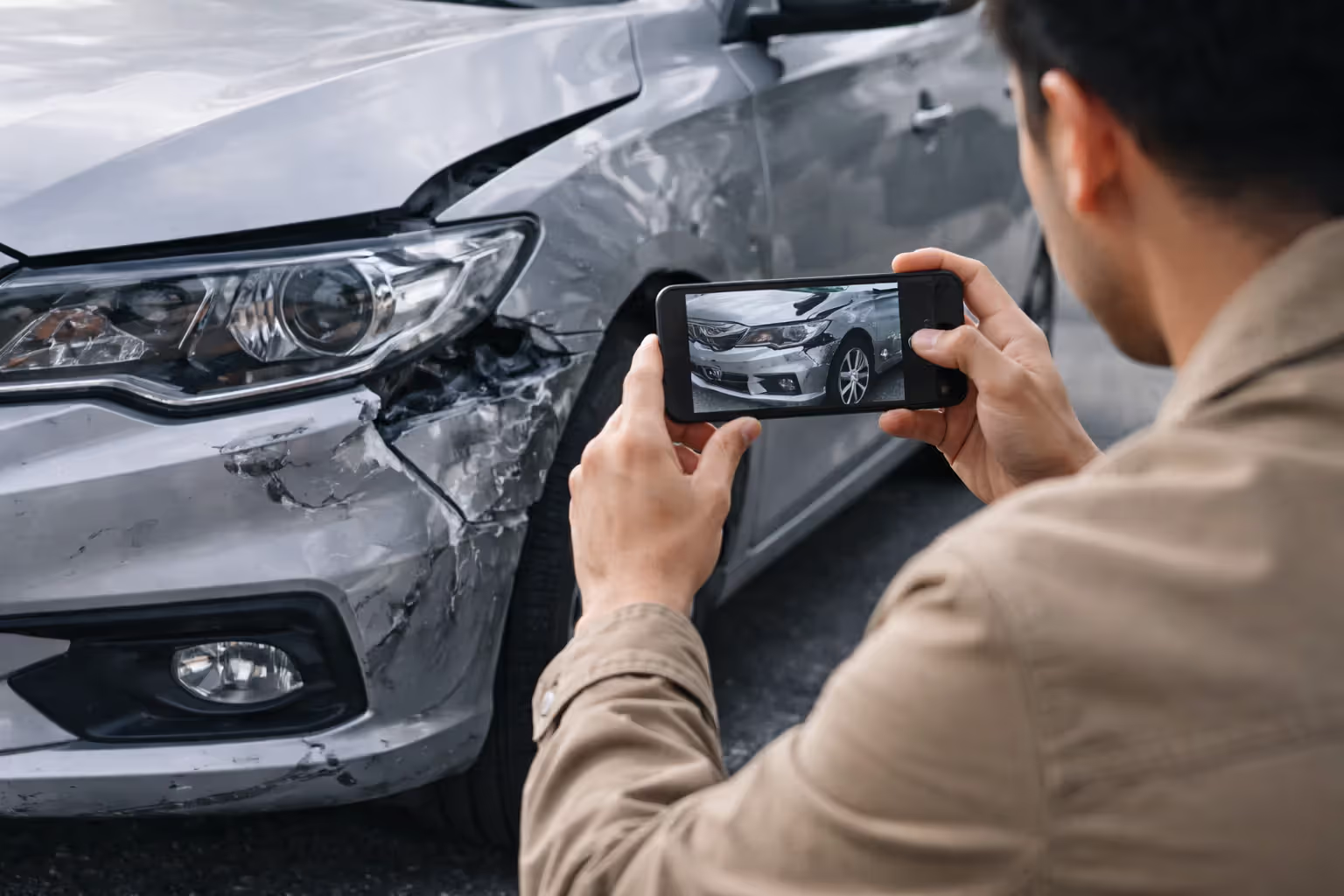
Progressive handles roughly 3 million claims annually, and the company has invested heavily in technology to streamline the process. You can report claims through the mobile app, website, phone, or by visiting a service center. The app lets you photograph damage, track repair status, and communicate with adjusters without phone tag.
For straightforward claims (single-vehicle comprehensive damage, clear-fault accidents), Progressive moves quickly. Glass claims often get approved within hours, and you can drive straight to a Safelite location for same-day replacement. Minor collision repairs typically start within 3-5 business days after inspection.
J.D. Power's 2023 Auto Claims Satisfaction Study ranked Progressive slightly below the industry average, scoring 871 out of 1,000 compared to the 880 industry mean. The company performs best on speed (claims are processed quickly) and worst on communication (customers report difficulty reaching the same adjuster consistently).
Progressive has built an efficient claims operation that works well for clear-cut cases, but their focus on automation and cost control can create frustration when claims involve disputed liability or injury complexities. Customers need to be prepared to advocate for themselves.
— Amy Bach
Common complaints about Progressive's claims handling cluster around three issues:
Lowball initial offers on total loss claims. Progressive determines actual cash value using proprietary software that pulls comparable vehicle sales data. Customers frequently report that first offers come in 10-15% below what similar cars are selling for locally. You have the right to dispute this valuation with evidence of comparable listings, but it requires effort and persistence.
Difficulty with injury claims. If you're injured in an accident, Progressive's bodily injury adjusters take a notably conservative approach to settlement. Multiple consumer advocates report that Progressive often requires extensive medical documentation and independent medical exams before making offers, and initial offers tend toward the low end. Serious injury claims almost always benefit from attorney representation.
Inconsistent communication. Progressive uses a team-based claims model where multiple people might touch your file rather than assigning one dedicated adjuster. This improves efficiency (someone's always available) but frustrates customers who have to re-explain their situation to different people. The app-based messaging helps somewhat, but complex claims still require phone conversations.
Progressive's Concierge Level of Service program (available to platinum policy holders or for an additional fee) provides a dedicated adjuster, rental car delivery, and repair shop coordination. Customer satisfaction scores for concierge claims run 15-20 points higher than standard claims, but the service costs $50-75 annually.
For minor claims under $2,000, Progressive's process works smoothly. You'll get quick decisions, digital payments, and minimal hassle. For major claims—especially total losses or injury claims—expect to do homework. Document everything, get independent repair estimates or vehicle valuations, and don't accept the first offer without verification.
One underappreciated aspect: Progressive's network of direct repair shops (Progressive Advantage Program) guarantees repairs for as long as you own the vehicle. If you use an in-network shop, you'll get faster approval and a lifetime warranty on the work. Out-of-network shops might provide better craftsmanship in some cases, but you assume more risk if problems emerge later.
Author: Brandon Whitaker;
Source: trialstribulations.net
FAQ: Common Questions About Progressive Insurance
Progressive delivers the strongest value proposition for three specific groups: drivers with blemished records who face sky-high rates elsewhere, tech-comfortable customers who want robust digital tools, and households with multiple vehicles or policies to bundle. If you fit one of these profiles, Progressive likely belongs in your quote comparison.
The company stumbles with white-glove service expectations and doesn't always reward perfect driving records as generously as competitors. Customers who value personal relationships with agents or who have pristine records spanning decades might find better fits at State Farm, USAA, or regional carriers.
Before committing to Progressive, get quotes from at least three competitors—ideally including one national carrier (Geico, State Farm) and one regional insurer strong in your state. Insurance pricing is hyper-individualized; the company that's cheapest for your neighbor might be expensive for you based on subtle differences in credit scores, vehicle models, or coverage preferences.
If you choose Progressive, maximize value by enrolling in Snapshot (you can always cancel if results disappoint), stacking every applicable discount, and using the mobile app for policy management and claims. For claims exceeding $5,000 or involving injuries, document everything meticulously and don't hesitate to push back on initial offers with comparable data.
Progressive has earned its position as America's third-largest auto insurer through competitive pricing for non-standard risks and genuine technological innovation. Whether it's worth your money depends less on the company's overall reputation and more on how well its specific strengths align with your individual circumstances.